The Last Time Again Bass Cover
| "The Last Time" | ||||
|---|---|---|---|---|
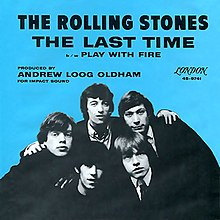 1965 Us unmarried picture sleeve | ||||
| Single past the Rolling Stones | ||||
| B-side | "Play with Burn down" | |||
| Released |
| |||
| Recorded | 11–12 Jan 1965 | |||
| Studio | RCA, Hollywood, California | |||
| Genre | Garage rock, difficult rock[ane] | |||
| Length | 3:41 | |||
| Label |
| |||
| Songwriter(due south) | Jagger/Richards[two] | |||
| Producer(southward) | Andrew Loog Oldham[2] | |||
| The Rolling Stones Uk singles chronology | ||||
| ||||
| The Rolling Stones US singles chronology | ||||
| ||||
| Audio sample | ||||
| ||||
"The Last Fourth dimension" is a vocal by the English rock band the Rolling Stones, and the ring's outset original vocal released every bit an A-single in the UK.[ii] Written by Mick Jagger and Keith Richards, and recorded at RCA Studios in Hollywood, California in January 1965, "The Terminal Fourth dimension" was the band's third UK single to reach number one on the Great britain Singles Nautical chart, spending iii weeks at the pinnacle in March and early April 1965.[3] It reached number two in the Irish Singles Nautical chart in March 1965, and was released on the US version of the album Out of Our Heads on 30 July 1965.
Limerick [edit]
Although "The Last Time" is credited to Jagger/Richards, the vocal's refrain is like to "This May Exist the Final Time", a traditional gospel song recorded in 1954 by the Staple Singers. In 2003, Richards acknowledged this,[four] maxim, "Nosotros came upwards with 'The Final Time', which was basically re-adapting a traditional gospel song that had been sung by the Staple Singers, but luckily the vocal itself goes back into the mists of time." The Rolling Stones' song has a main melody and a hook (a distinctive guitar riff) that were both absent-minded in the Staple Singers' version. Phil Spector, whose "Wall of Sound" approach can exist heard on the recording, assisted with the production.
Cash Box described it equally "a raunchy, hard-driving romantic blueser about a twosome who are destined to split up."[5]
Live performance [edit]
Footage exists of a number of performances of this song past the Rolling Stones in 1965: from the popular BBC-Tv music bear witness Top of the Pops, the 1965 New Musical Express Poll Winners Concert and American Goggle box shows including The Ed Sullivan Bear witness and Shindig!. A total alive functioning is also prominently featured in the 2012 re-edit of the 1965 documentary Charlie Is My Darling. The footage confirms that the rhythm chords and guitar solo were played by Keith Richards, while the song's distinctive hook was played by Brian Jones. In the August 1965 effect of Beat Instrumental, in respond to the question of "who plays the prominent effigy on The Stones releases?", Keith Richards said "I played information technology on 'Satisfaction', Brian played information technology on 'The Last Fourth dimension'. It all depends who thinks it upwards."[6]
A popular song in the Stones' catechism, information technology was regularly performed in concert during the ring's 1965, 1966 and 1967 tours. It was left off their concert set lists until 1997–98, when information technology reappeared on the Bridges to Babylon Bout. Information technology afterward appeared on some of the band'southward set lists in 2012–13 on the 50 & Counting tour.
Personnel [edit]
Co-ordinate to authors Philippe Margotin and Jean-Michel Guesdon:[7]
The Rolling Stones
- Mick Jagger – pb vocal[note 1]
- Keith Richards – backing vocals, acoustic guitar, rhythm guitar, lead guitar (solo)
- Brian Jones – pb guitar (riff)
- Bill Wyman – bass
- Charlie Watts – drums
Additional personnel
- Jack Nitzsche – tambourine
Charts [edit]
| Chart (1965) | Peak position |
|---|---|
| Australia (Kent Music Study)[8] | ii |
| Austria (Ö3 Republic of austria Elevation xl)[9] | 7 |
| Kingdom of belgium (Ultratop 50 Flanders)[10] | iv |
| Canada Top Singles (RPM)[eleven] | 9 |
| Germany (Official German Charts)[12] | ane |
| Ireland (IRMA)[13] | 2 |
| Netherlands (Single Top 100)[xiv] | one |
| Kingdom of norway (VG-lista)[15] | ane |
| Due south Africa (Springbok)[16] | seven |
| UK Singles (OCC)[17] | 1 |
| US Billboard Hot 100[xviii] | 9 |
The Andrew Oldham Orchestra version [edit]
In 1965, Andrew Oldham Orchestra recorded the song for the anthology The Rolling Stones Songbook. The recording and its distinctive passage for strings was written and arranged by David Whitaker.[19] [20]
Copyright issue [edit]
In 1997, sometime Rolling Stones business director Allen Klein, whose company ABKCO Records owns the rights to all Rolling Stones material from the 1960s, sued English language stone band the Verve for using a sample of the Andrew Oldham Orchestra recording of "The Last Fourth dimension" in their hit song "Biting Sweet Symphony". The Verve had obtained a licence to apply the sample, merely Klein successfully argued that the band used more than than the licence covered. The Verve were required to relinquish 100% of their royalties from their hit song to ABKCO and the songwriting credit was changed to Jagger/Richards/Ashcroft. This led to Andrew Loog Oldham, who owns the copyright on the orchestral rendition that was sampled, also suing the Verve.[21]
In May 2019, Richard Ashcroft appear that the Stones had handed over their copyrights on the vocal to him.[22]
The Who version [edit]
| "The Final Time" | ||||
|---|---|---|---|---|
| Single past The Who | ||||
| B-side | "Under My Thumb" | |||
| Released | xxx June 1967 (1967-06-thirty) | |||
| Recorded | 28 June 1967 | |||
| Studio | De Lane Lea, London | |||
| Length | three:02 | |||
| Characterization | Track | |||
| Songwriter(s) | Jagger/Richards | |||
| Producer(south) | Kit Lambert | |||
| The Who UK singles chronology | ||||
| ||||
In 1967, after the imprisonment of Jagger and Richards on drugs charges, the Who recorded "The Last Time" and "Under My Thumb" as a single. The intention was to assist Jagger and Richards make bail, but past the time the single was made bachelor, they had been released. The songs were rush recorded and the record appeared in shops in only one calendar week. As John Entwistle was abroad on his honeymoon he authorised the Who to practice the tape without him and bass parts were overdubbed by Pete Townshend. The United kingdom-only release reached number 44 on the UK Singles Chart.
Other renditions [edit]
American country music vocalizer Bobby Bare covered the vocal on his 1978 album, Sleeper Wherever I Autumn.
In 1997, country music group the Tractors covered the song on the album Stone Country: Country Artists Perform the Songs of the Rolling Stones. Their version peaked at number 75 on the Billboard Hot Country Singles & Tracks chart.[23]
Australian vocalizer John Farnham covered the vocal in 2002, every bit the lead single and title track of his 2002 anthology, The Terminal Fourth dimension.[24]
The aforementioned hook was sampled in several subsequent recordings by other artists, about notably in "Number 1" by Tinchy Stryder featuring N-Dubz, which reached number ane in the UK Singles Chart,[25] in the calendar week of its official release on xx April 2009.
Notes [edit]
- ^ Margotin and Guesdon are uncertain, merely advise Jagger may have also provided backing vocals.[seven]
References [edit]
- ^ Dean, Maury (6 June 2003). Rock Due north Roll Gilded Rush: A Singles Un-Cyclopedia. Algora Publishing. p. 169. ISBN9780875862279 – via Google Books.
- ^ a b c d Rice, Jo (1982). The Guinness Book of 500 Number One Hits (1st ed.). Enfield, Middlesex: Guinness Superlatives Ltd. pp. 89–xc. ISBN0-85112-250-seven.
- ^ Roberts, David (2006). British Hit Singles & Albums (19th ed.). London: Guinness World Records Express. p. 176. ISBN1-904994-x-5.
- ^ Jagger, Mick; Richards, Keith; Watts, Charlie; Wood, Ronnie (2003). Co-ordinate to the Rolling Stones . Chronicle Books. p. 92. ISBN0811840603.
- ^ "CashBox Record Reviews" (PDF). Cash Box. xx March 1965. p. 10. Retrieved 12 January 2022.
- ^ Beat Instrumental, No. 28, August 1965.
- ^ a b Margotin & Guesdon 2016, p. 110.
- ^ Kent, David (1993). Australian Chart Volume 1940-1969. St Ives, North.South.W.: Australian Nautical chart Book. ISBN0-646-11917-vi.
- ^ "The Rolling Stones – The Last Fourth dimension" (in German language). Ö3 Austria Summit forty. Retrieved 17 June 2016.
- ^ "The Rolling Stones – The Last Fourth dimension" (in Dutch). Ultratop fifty. Retrieved 17 June 2016.
- ^ "Top RPM Singles: Effect 5624." RPM. Library and Athenaeum Canada. Retrieved 17 June 2016.
- ^ "The Rolling Stones – The Concluding Time" (in German). GfK Amusement charts. Retrieved 17 June 2016.
- ^ "The Irish Charts – Search Results – The Last Time". Irish Singles Nautical chart. Retrieved 18 June 2016.
- ^ "The Rolling Stones – The Last Fourth dimension" (in Dutch). Unmarried Top 100. Retrieved 17 June 2016.
- ^ "The Rolling Stones – The Concluding Time". VG-lista. Retrieved 17 June 2016.
- ^ "SA Charts 1965–March 1989". Retrieved five September 2018.
- ^ "Rolling Stones: Artist Chart History". Official Charts Company. Retrieved 17 June 2016.
- ^ "The Rolling Stones Nautical chart History (Hot 100)". Billboard. Retrieved 17 June 2016.
- ^ "DAVID SINCLAIR WHITAKER: Sweet Symphony". Soundonsound.com. Archived from the original on nineteen March 2014. Retrieved 5 April 2014.
- ^ Bob Stanley. "David Whitaker obituary | Music". The Guardian . Retrieved v Apr 2014.
- ^ "The Verve Sued Again over "Bitter Sweet Symphony" Archived 1 October 2007 at the Wayback Machine VH1, eleven Jan 1999
- ^ Vozick-Levinson, Simon (23 May 2019). "Rolling Stones Finally Give Back 'Bitter Sweet Symphony' Songwriting Credits". Rolling Stone . Retrieved 20 Nov 2021.
- ^ Whitburn, Joel (2013). Hot Country Songs 1944–2012. Record Research, Inc. p. 339. ISBN978-0-89820-203-8.
- ^ Holmgren, Magnus; Reboulet, Scott; Albury, Lyn; Birtles, Beeb; Warnqvist, Stefan; Medlin, Peter. "John Farnham". Passagen.se. Australian Rock Database (Magnus Holmgren). Archived from the original on 27 November 2013. Retrieved xvi May 2014.
- ^ [ane] Archived 14 March 2009 at the Wayback Machine
Sources [edit]
- Margotin, Philippe; Guesdon, Jean-Michel (2016). The Rolling Stones All the Songs: The Story Behind Every Rail. New York: Black Canis familiaris & Leventhal Publishers. ISBN978-0-316-31774-0.
Source: https://en.wikipedia.org/wiki/The_Last_Time_(Rolling_Stones_song)
0 Response to "The Last Time Again Bass Cover"
Enviar um comentário