Aranikos Artistic Legacy and Its Influence on the Buddhist Arts in China
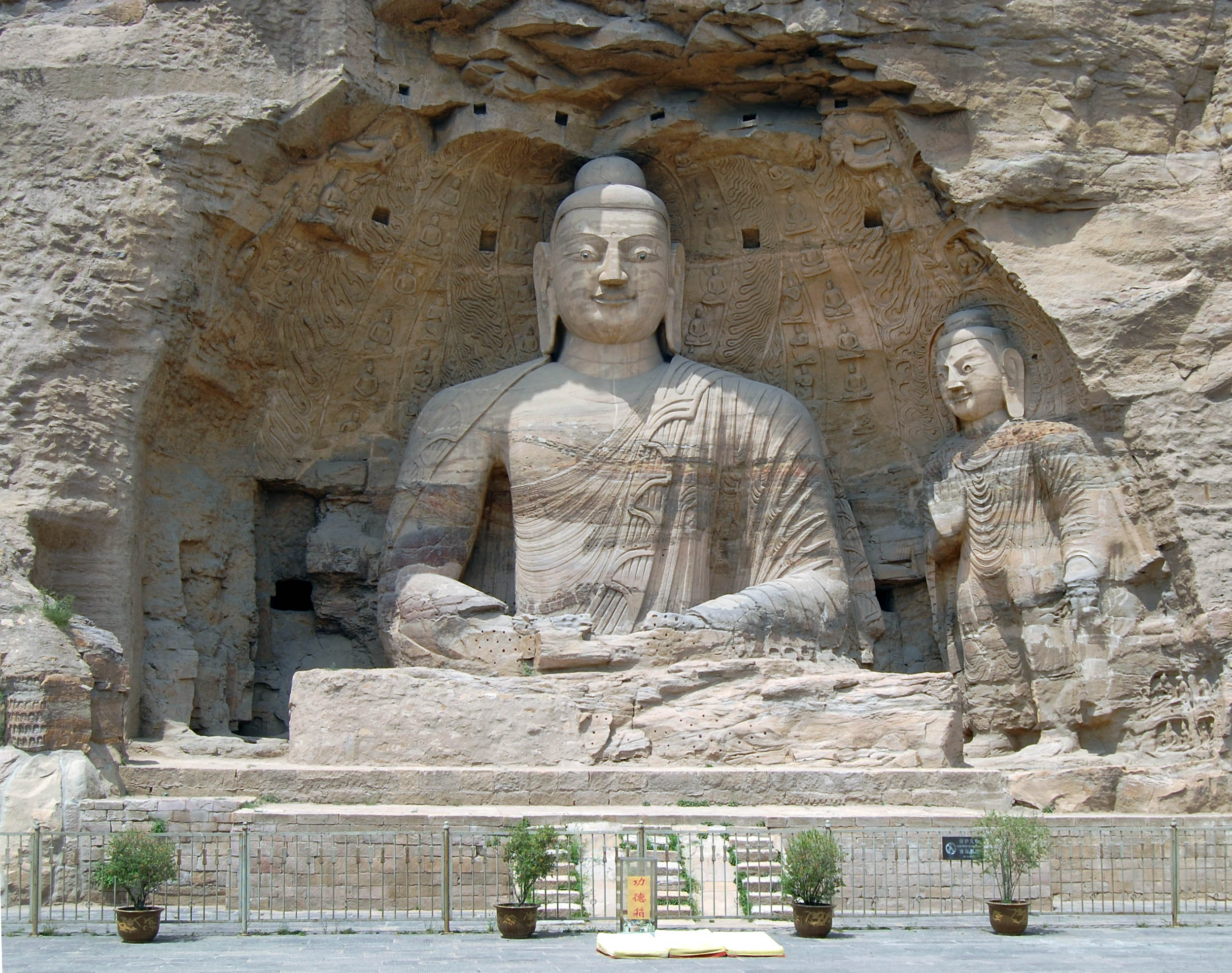
Buddha, Cavern 20 at Yungang, Datong, China, c. 460 C.East. (photo: Marcin Białek, CC Past-SA iv.0)
The story of Buddhist art in Mainland china is one of dynamic cultural and creative exchange beginning with the earliest images of the Buddha based on Indian and Central Asian prototypes through its eventual
Background to Buddhism
To understand early Chinese Buddhist art, we must commencement travel back in time hundreds of years and across Eurasia to ancient India and the origins of Buddhism. Buddhism was founded past prince Siddhartha Gautama, who became the Historical Buddha (also known as Shakyamuni) after his enlightenment (nirvana).
Read essays about Buddhism
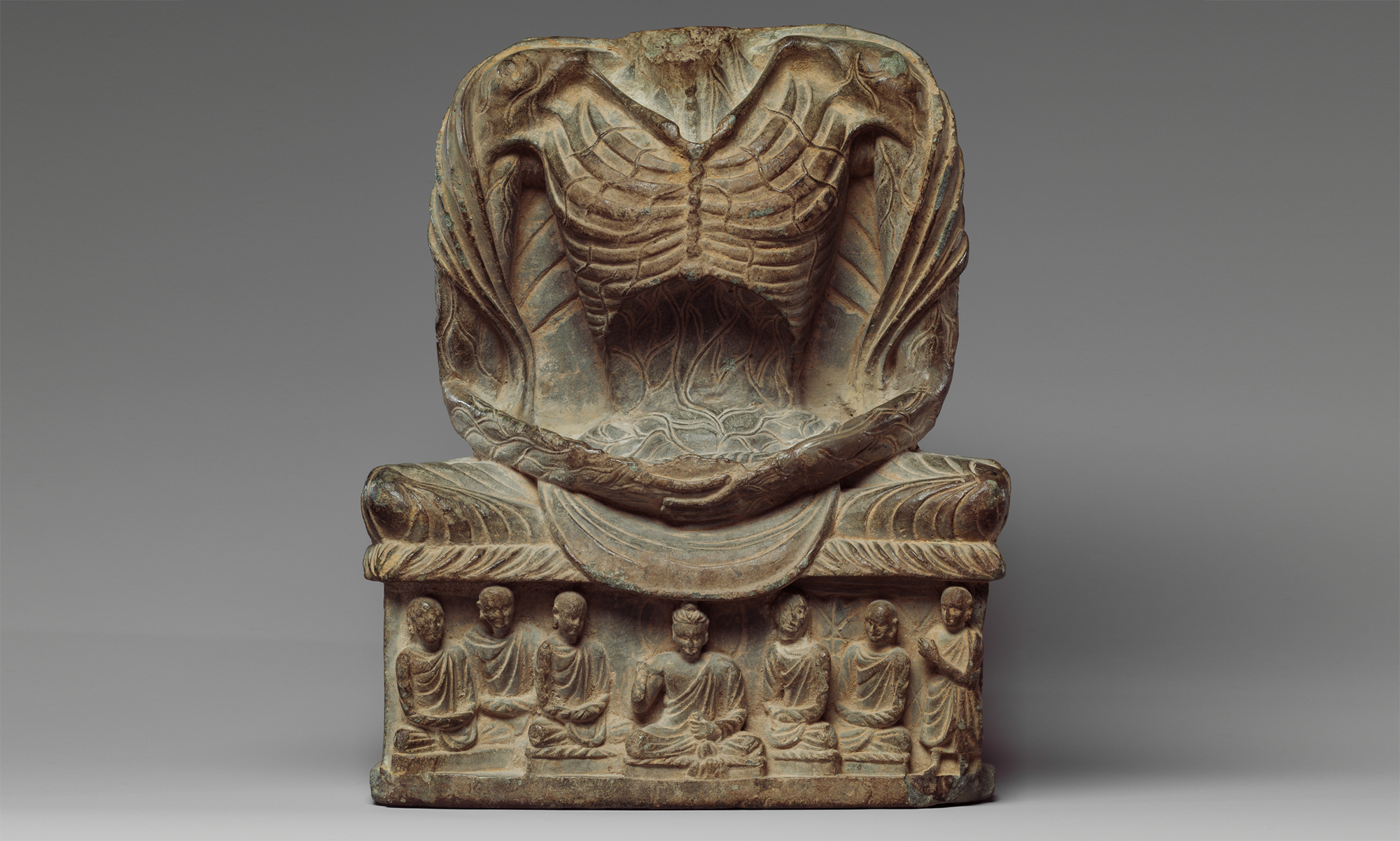
The historical Buddha: an introduction
Read Now
/2 Completed
Early Buddhist art
Early Buddhist fine art (whether in South Asia, Central Asia, or Due east Asia), focuses on visual depictions of the Historical Buddha and narratives of his life story and past lives . Early Buddhist art is aniconic, meaning the Buddha is not represented in human form.
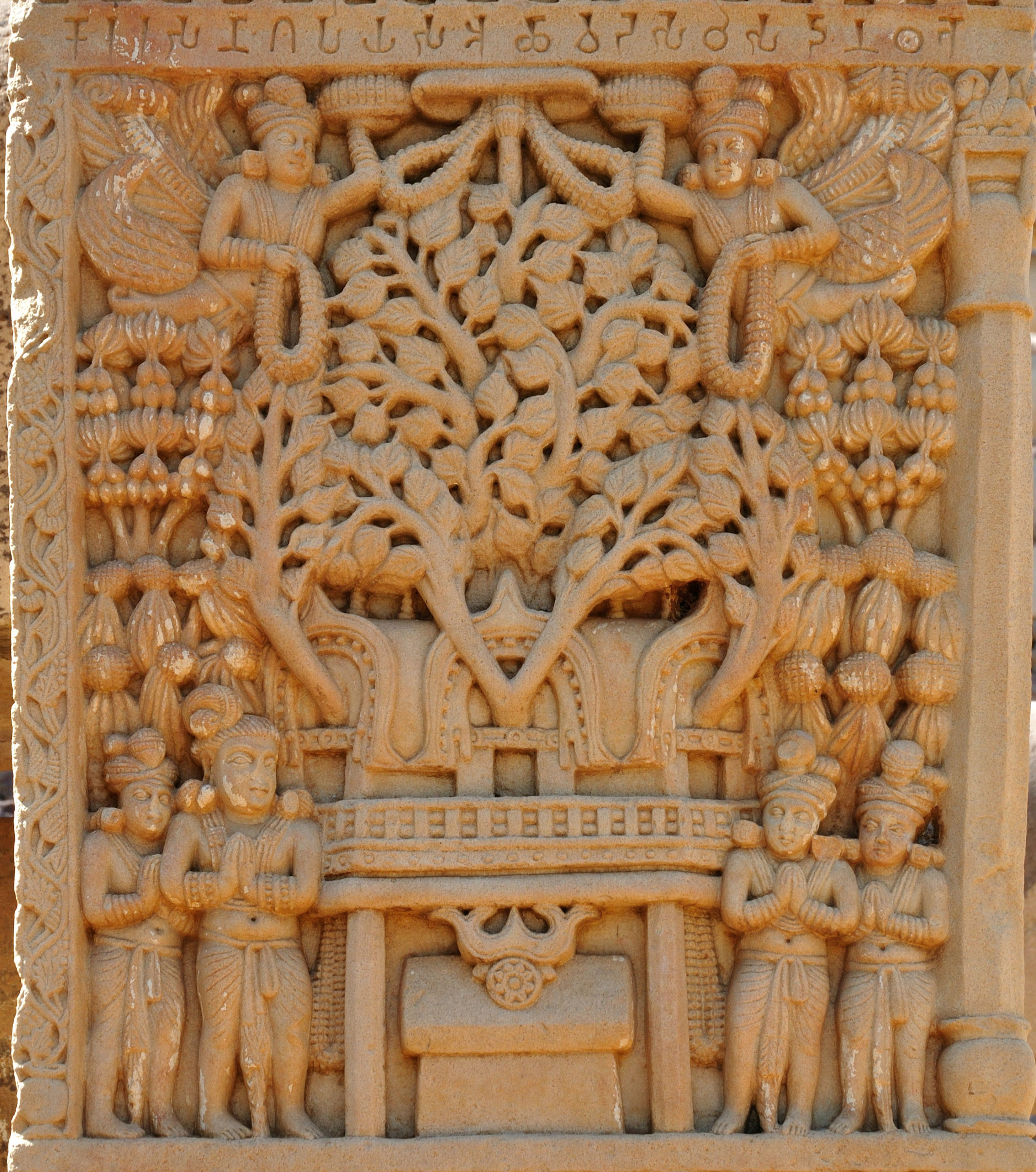
The earliest images of the Buddha appear to avert depicting him in human form, and sometimes refer to him with forms similar a bodhi tree. The fig tree nether which the Buddha reached enlightenment became known as the Bodhi ("awakened" or "enlightened") tree. Bodhi tree with shrine, eastern gateway, Sanchi Stupa no. 1, 2nd–1st century B.C.Due east., Bharat (photo: Biswarup Ganguly CC Past iii.0)
Instead, Buddha is represented using symbols, such equally the Bodhi tree (where he attained enlightenment), a bike (symbolic of Dharma or the Bike of Constabulary), and a parasol (symbolic of the Buddha'southward royal background), just to proper name a few. The use of symbols to depict the Buddha may accept been inspired by his achievement of parinirvana and release from the cycle of rebirth (samsara) and existence in a physical form upon his death.

The cantankerous-legged Bodhisattva Maitreya is shown hither, on the eastward wall of the vestibule of Cavern ix, phase 2, afterward 650, Yungang Grottoes, Datong, Red china (photo: G41rn8, CC BY-SA 4.0)
As Buddhist art adult over time, the Historical Buddha was eventually depicted in human form. [i] Bodhisattvas, enlightened beings who postpone consummate liberation (parinirvana) from the bicycle of rebirth (samsara) to help others achieve enlightenment, were also incorporated into the vocabulary of Buddhist art. The bodhisattvas that appear most frequently in Buddhist art are frequently introduced by their Sanskrit names. In Chinese art, the bodhisattvas Avalokitesvara (Guānyīn 觀音 in Chinese) and Maitreya (Mí-lè 彌勒 in Chinese) are among the most frequently represented. Guanyin, the bodhisattva of pity, hears the cries of the suffering, while Mi-le offers hope for the future in times of despair.
Read essays about images of the Buddha and bodhisattvas
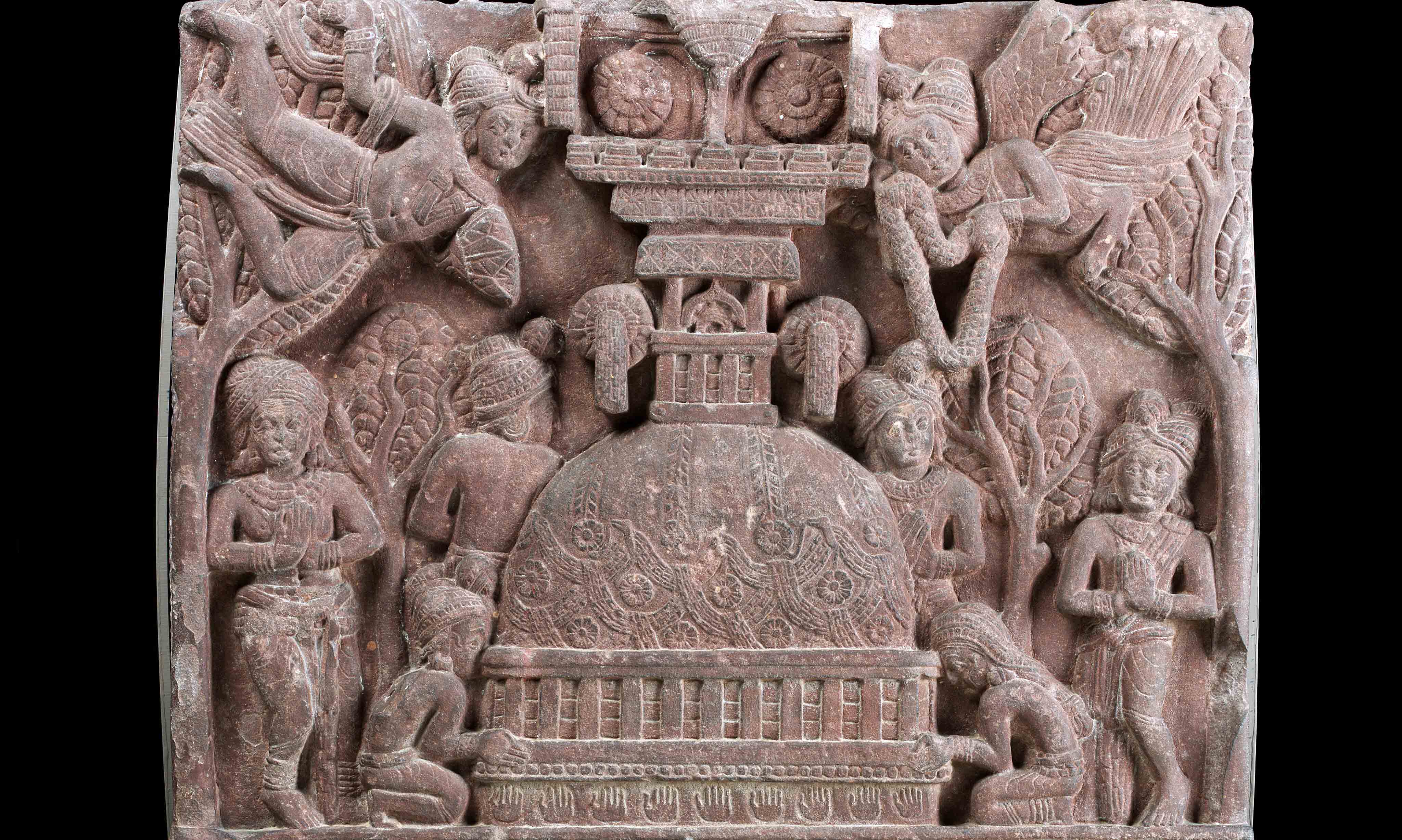
Images of enlightenment: aniconic vs. iconic depictions of the Buddha in Republic of india
Read Now
/3 Completed
Early Chinese Buddhist Fine art
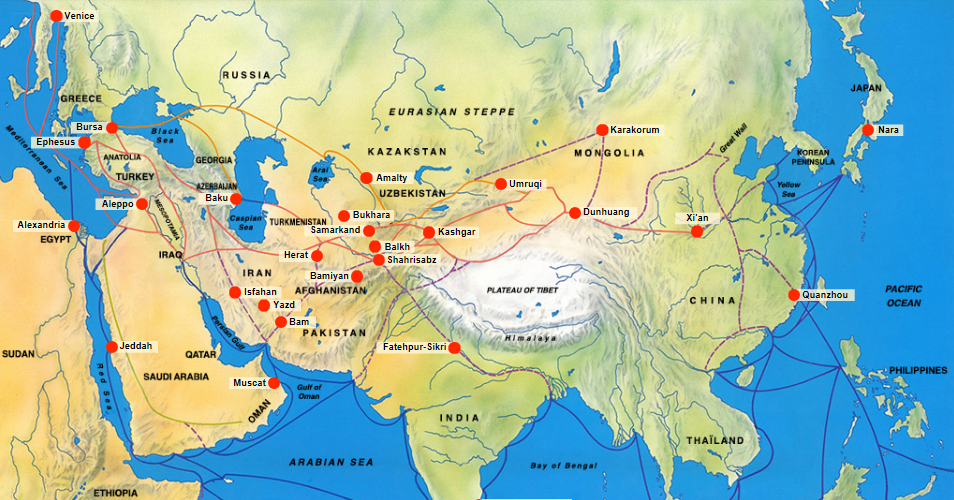
Map of the Silk Roads (various overland routes across Eurasia)
Buddhism first arrived in China during the Han dynasty (206 B.C.E.–220 C.E.). The earliest visual images of the Buddha to get in in Cathay were likely drawings and modest portable images from India and Central Asia transmitted by travelers along the ancient Silk Roads. As early on equally the second century, local artisans in Prc produced their own images and sculptures of the Buddha using foreign models.
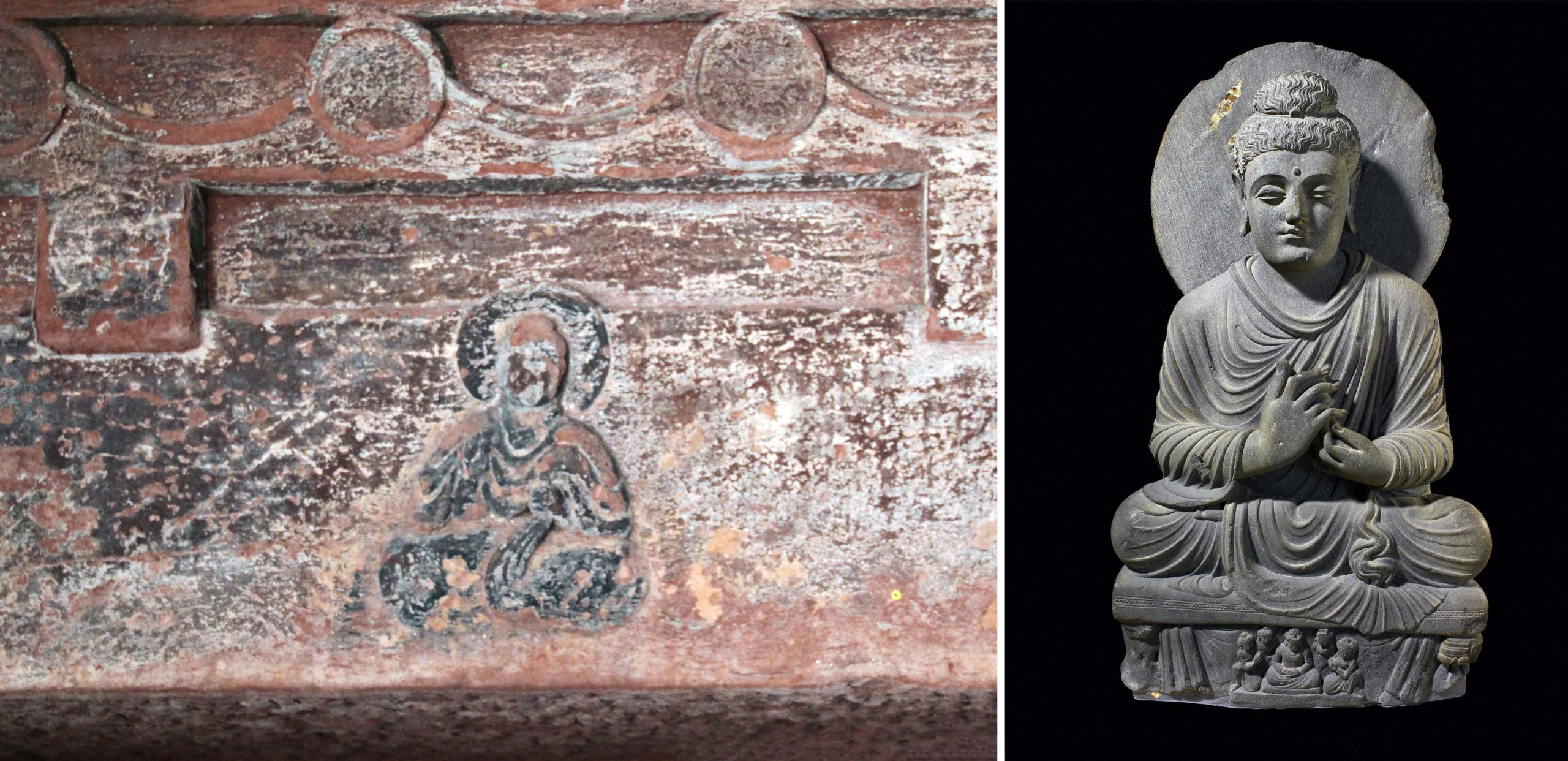
Left: Seated Buddha, Mahao Cliff Tomb, Sichuan Province, Eastern Han Dynasty, late 2d century C.Eastward. (photo: Gary Todd, CC0); correct: Seated Buddha from Gandhara, c. 2nd–third century C.E., Gandhara, schist (© Trustees of the British Museum)
1 of the primeval images is a carving of a seated Buddha wearing a Gandharan-way robe discovered in a tomb dated to the late 2 nd century C.East. (Eastern Han) in Sichuan province. [2] Aboriginal Gandhara (located in present-24-hour interval Afghanistan, Pakistan, and northwest Bharat) was a major center for the production of Buddhist sculpture under Kushan patronage. The Kushans occupied portions of present-day Afghanistan, Pakistan, and north India from the 1 st through the 3 rd centuries and were the start to depict the Buddha in human being form. Gandharan sculpture combined local Greco-Roman styles with Indian and steppe influences. Compare the Chinese tomb carving of Buddha with the sculpture of a seated Buddha from Gandhara to a higher place, and notation the similarity in the mode the robe falls across the body in both images.
Rock-cut Cave Temples and Colossal Buddhas
Later on the autumn of the Han dynasty in 220 C.E., Cathay went through a period of upheaval before existence reunited again past the Sui dynasty in 581 C.E. Although this flow, known as the Menses of Division, is marked by instability and the rise and autumn of over 2 dozen dynasties and smaller kingdoms, arts and culture flourished. In part, this was due to the arrival of non-Chinese nomadic invaders and tribal groups, who successively conquered portions of north Communist china throughout this period. 1 clan, the non-Chinese Tuoba, united the due north in 439 C.E. and adopted Buddhism every bit the land religion. Buddhism grew in popularity under the rule of northern dynasties ruled by non-Chinese families, giving ascension to new artistic forms and styles based on foreign models. Over time, equally Buddhist art developed in People's republic of china, these foreign models were eventually Sinicized to legitimize the rule of non-Chinese nomadic rulers.
Read virtually the Menses of Sectionalisation (220–589 C.E.)
Period of Partitioning: an introduction
Read At present
/1 Completed
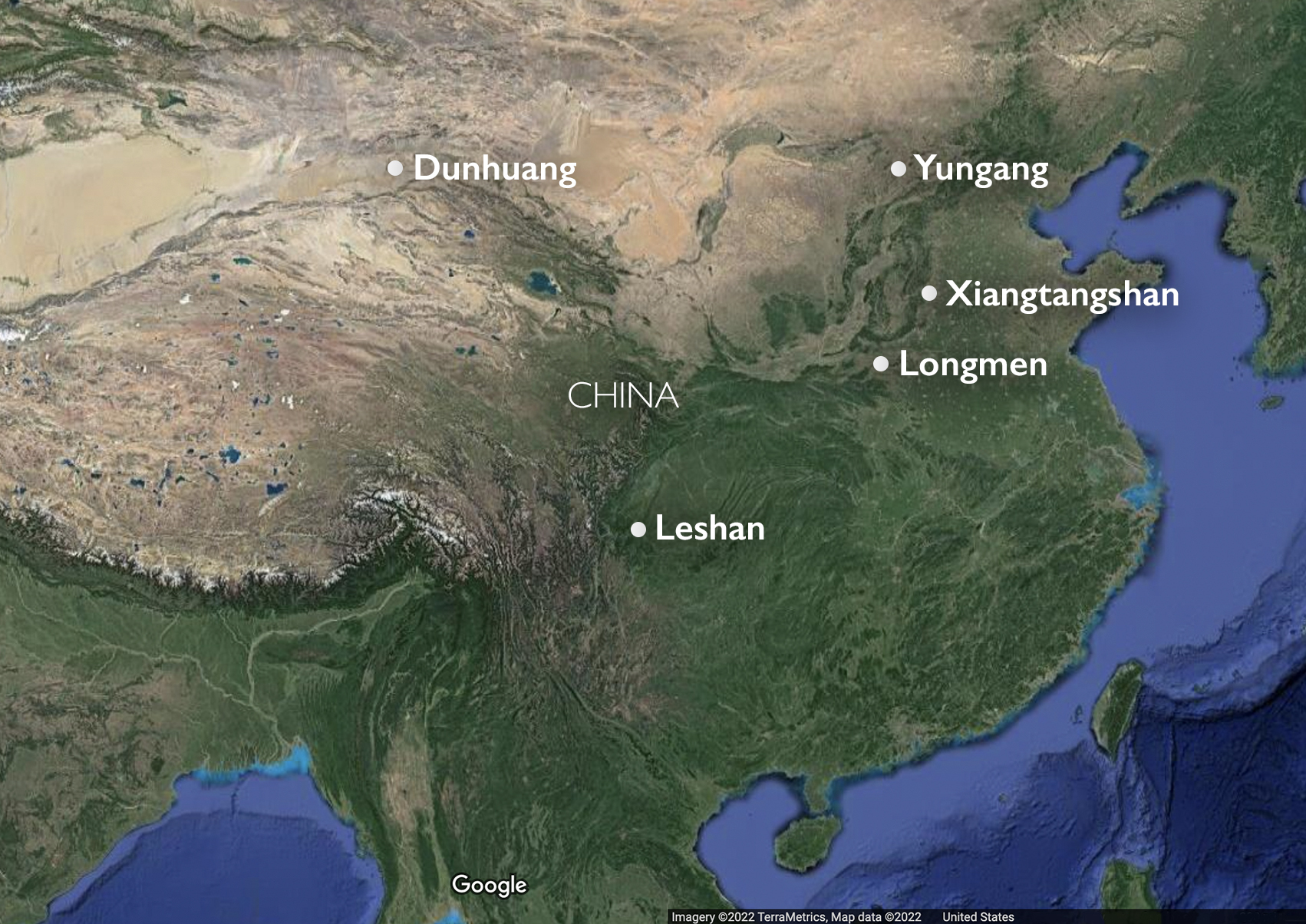
Map with locations of of import stone-cutting cave temples and colossal Buddhas in Communist china (underlying map © Google)
Stone-cut cave temples
During the Period of Division, rock cut cave temples were constructed at Yungang, Longmen, Dunhuang, and Xiangtangshan. These cavern temples, which were modeled afterward earlier cave temples in South Asia (such every bit at Ajanta ), feature thousands of images. The sculptures and paintings constitute within these caves help us empathize the history of the development of Buddhist art in Cathay. Construction at these cave temple sites began during the Menses of Division and continued during the Tang dynasty, a menstruum of peace and prosperity when China was one time again unified under ">Han Chinese purple dominion.
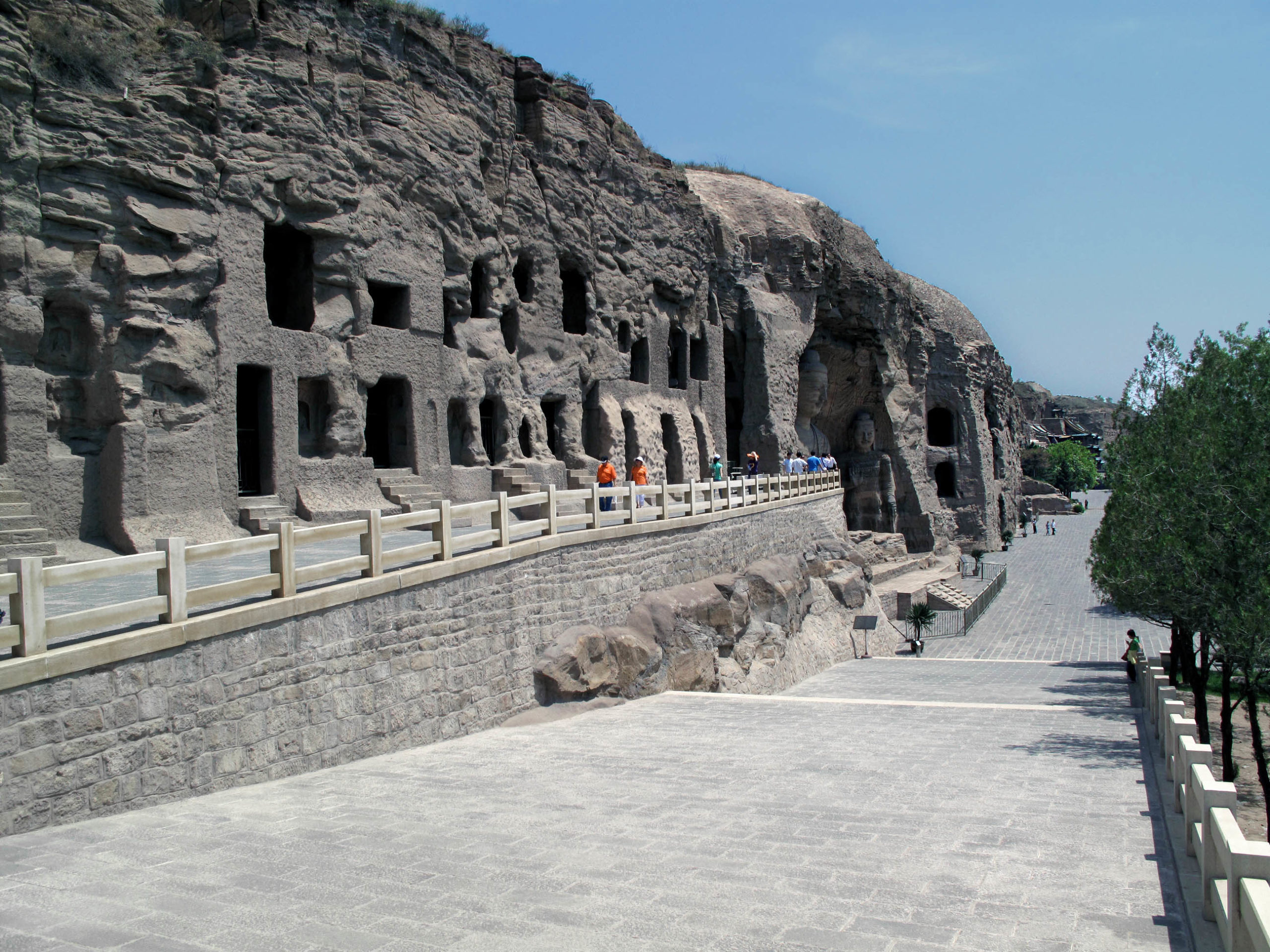
Caves and niches of Yungang,Datong in Shanxi province, Cathay, begun c. 460 C.E. (photo: G41rn8, CC BY-SA 4.0)
Yungang Caves
The Yungang grottoes are amidst the primeval rock-cut cave temples in China. They were carved under the patronage of Northern Wei rulers in the mid-five thursday century.
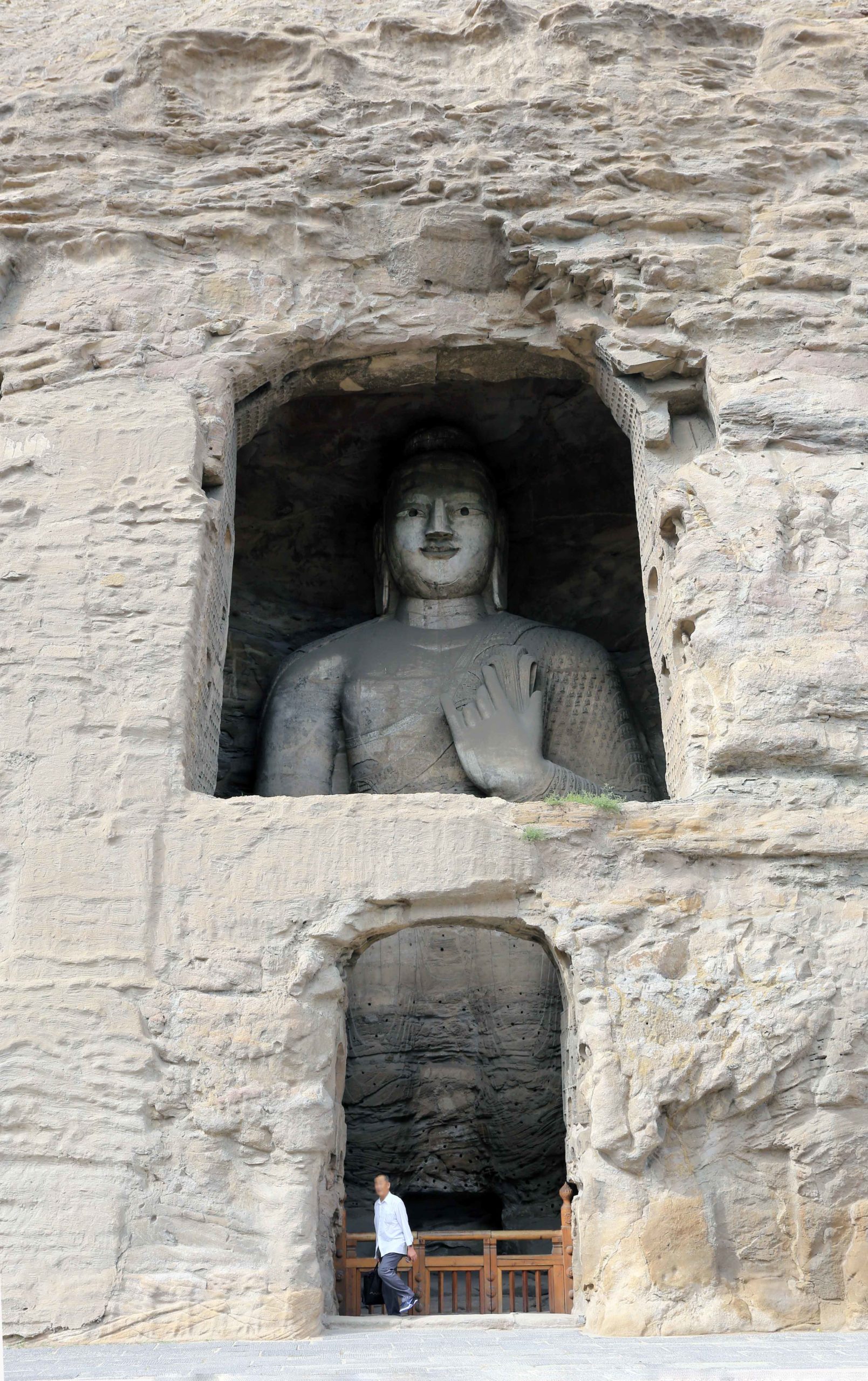
Buddha within Cave 18, Yungang, Datong, China, c. 460 C.Eastward. (photo: Zhangzhugang, CC BY-SA three.0)
The Buddhist imagery carved into the primeval caves (Caves 16, 17, 18, xix and 20), which each feature a jumbo Buddha, shows a confluence of artistic traditions from South, Central, and East Asia. Nevertheless, in the late five th century, Sinicization reforms under Emperor Xiaowen of the Northern Wei influenced the introduction of a new Chinese style of Buddhist art. This style is frequently referred to as the mature Northern Wei style, a Sinicized style of Buddhist fine art that moved away from traditional Indian and Central Asian styles. Sinicization reforms were used to legitimize the rule of non-Chinese rulers of the Northern Wei over a Chinese imperial dynasty.
Read an essay about the Yungang Caves
/1 Completed
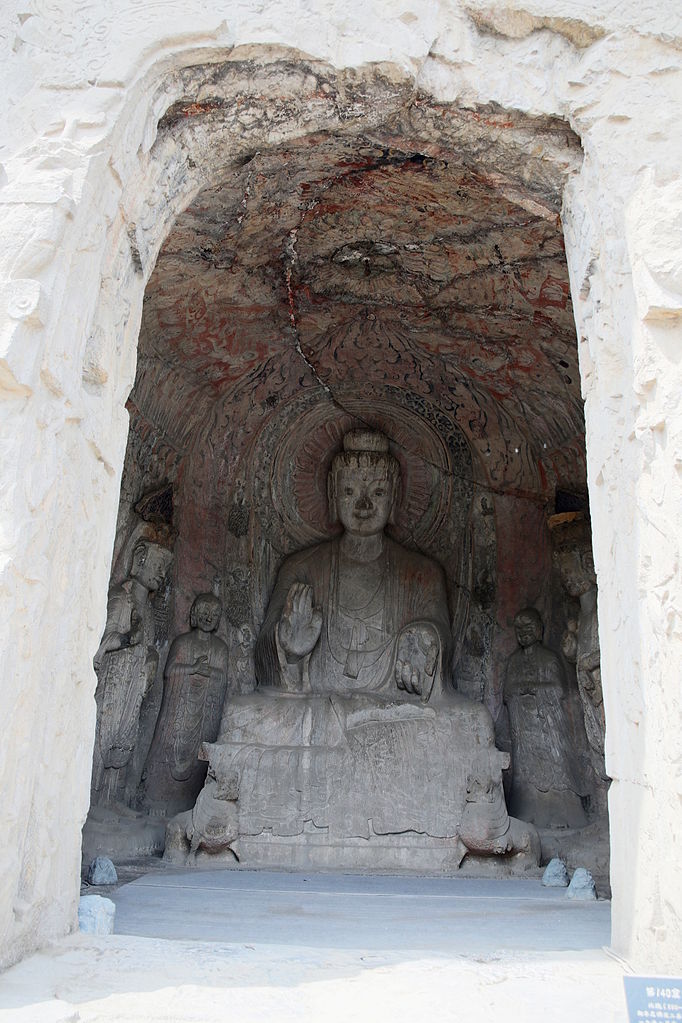
Entrance to Fundamental Binyang Cave, 508–523 C.E. Longmen Caves, Luoyang, China (photo: A1AA1A, CC0 one.0)
Longmen Caves
The construction of rock-cutting caves at Longmen besides began during the Northern Wei dynasty, afterwards the motion of the majuscule to nearby Luoyang in Henan province in 494 C.Due east. Northern Wei rulers completed one cave temple at Longmen, the Central Binyang Cave. Carved in the early 6 th century, the Key Binyang Cave was executed in the mature Northern Wei way.
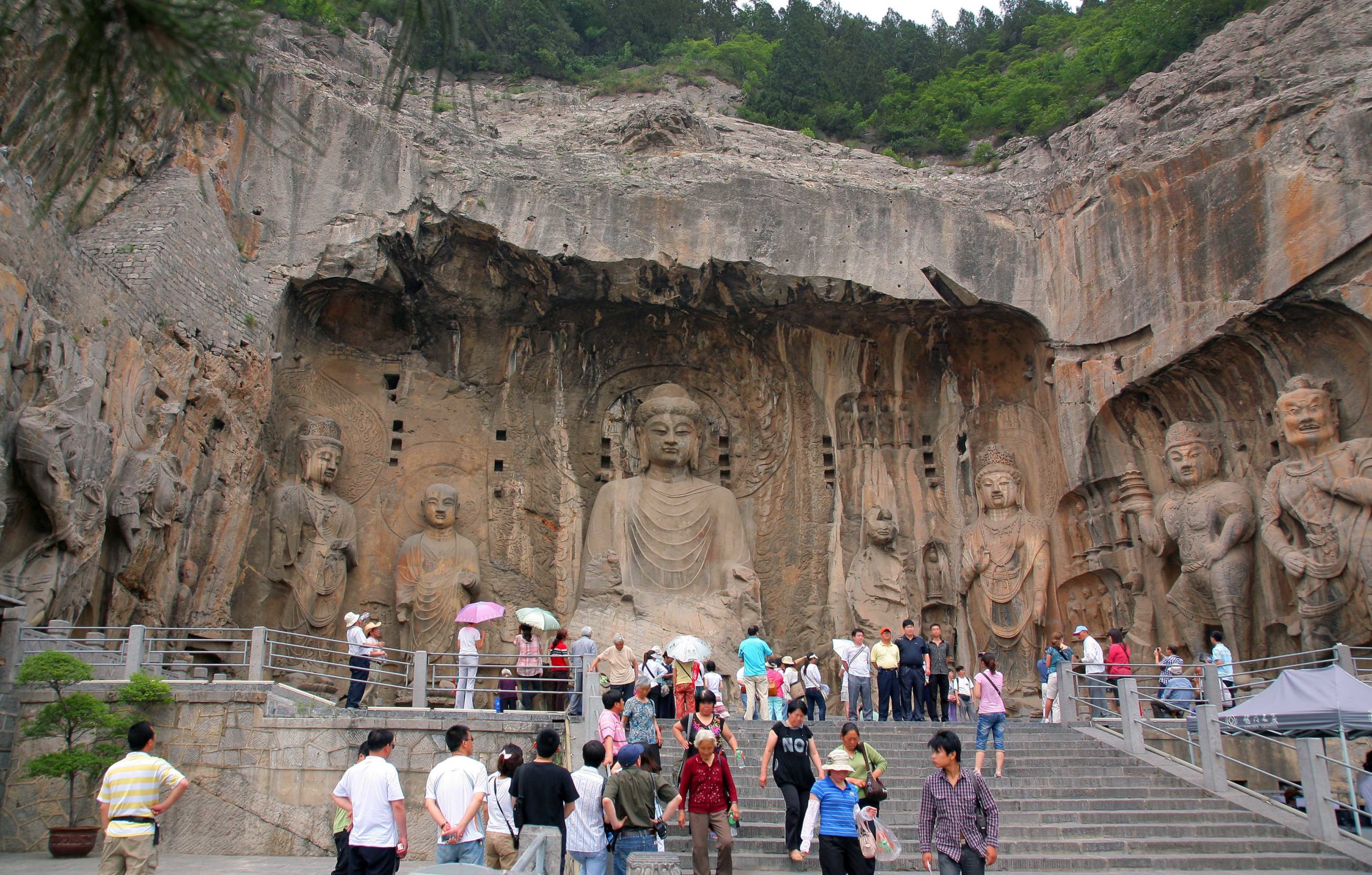
Vairocana Buddha, monks and bodhisattvas, 673–75 C.E., Tang dynasty, limestone, Luoyang, Henan province (Larry F. Brawl, CC BY-NC-SA 2.0)
Structure at the Longmen caves continued under Tang regal patronage with the carving of the Fengxian and Kanxing cave temples. Like the jumbo images of the Buddha in the early caves at Yungang, the Fengxian cave shrine features a awe-inspiring Buddha. Yet, instead of the Historical Buddha, the Fengxian cave features Vairocana Buddha on a dramatic phase-like setting flanked by colossal images of jeweled bodhisattvas, robed monks, heavenly kings, and thunderbolt bearers (vajrapani). Vairocana Buddha, the Catholic Buddha of the Flower Garland (Avatamsaka) Sutra , presides over infinite worlds, transcending time and space. The cave imagery was sponsored by Emperor Gaozong and his wife Empress Wu Zetian, who were patrons of the teachings of the Flower Garland Sutra. Similar to Northern Wei Buddhist cave monuments, the Fengxian cavern imagery can exist seen as a statement of imperial dominance. In this case, Tang purple rule is likened to that of the Cosmic Buddha Vairocana. [3]
Read an essay about the Longmen Caves
/1 Completed
Mogao Caves at Dunhuang
The Mogao, or "Peerless" caves, located nearly Dunhuang (an ancient haven town along the Silk Roads), in Gansu province, were commencement carved in the belatedly 4 th century by a pair of wandering monks. The monks carved small niches for lone meditation into a two-kilometer-long cliff located along the Daquan River in the middle of the desert.
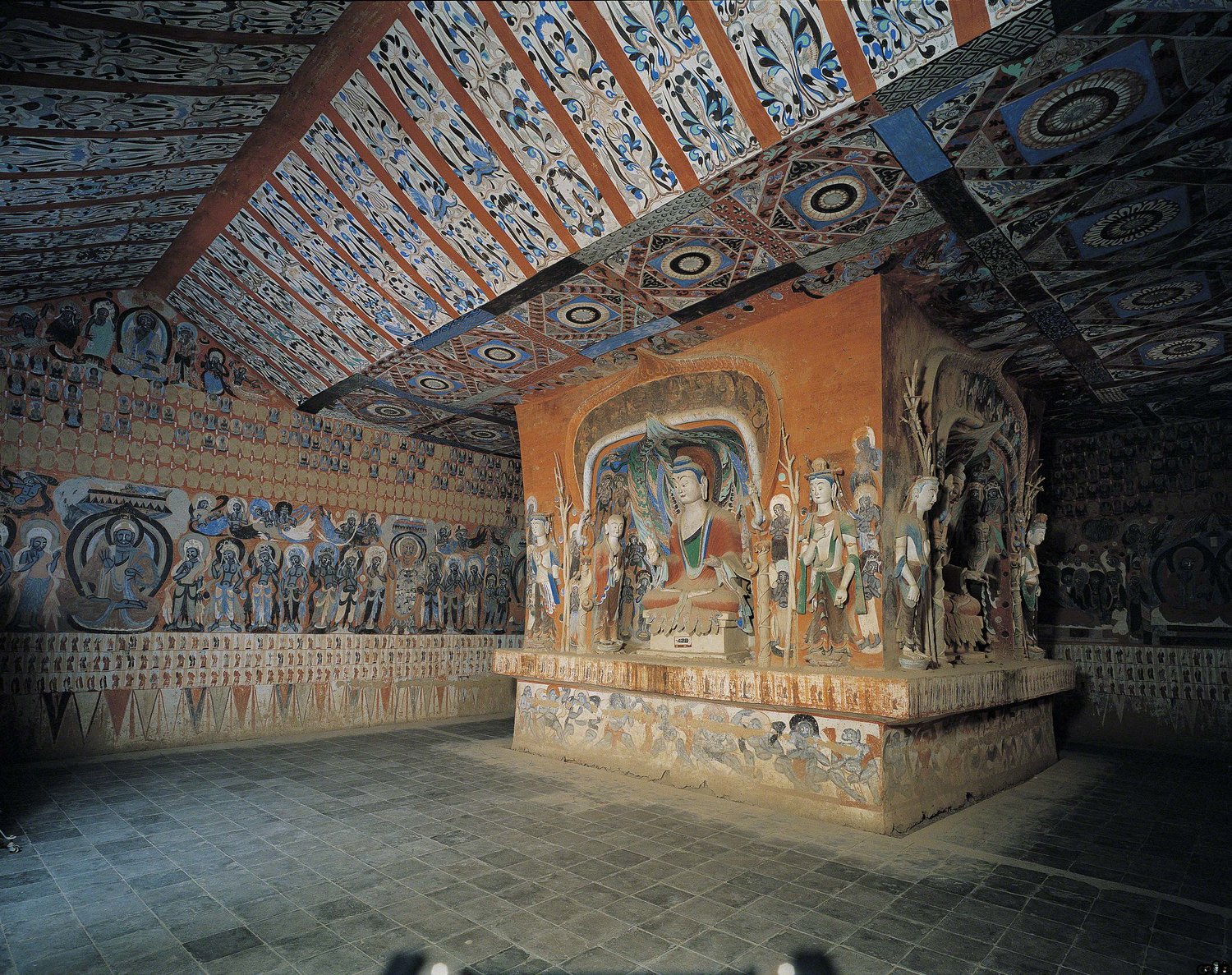
The central colonnade in Mogao Cave 428, Northern Zhou dynasty, 557–581 C.Eastward., Dunhuang (prototype courtesy of the Dunhuang Academy)
This site would somewhen become one of the most important centers for Buddhism in the world. From the half-dozen th through the 14 th centuries, over a thousand caves of diverse sizes were carved from the east facing cliff, many of which were decorated with paintings and sculptures, giving the site the nickname "Caves of the Thousand Buddhas."
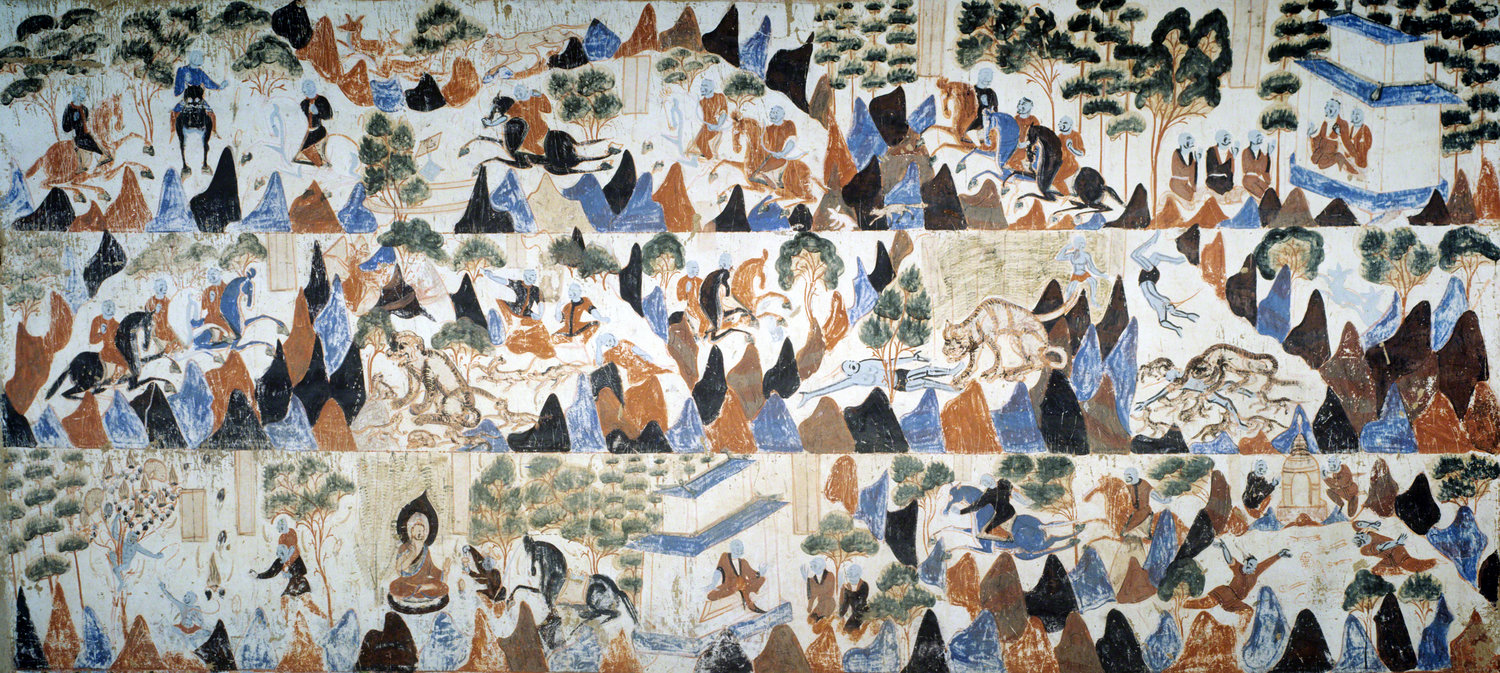
The consummate Prince Mahasattva jataka tale mural, Mogao Cave 428, Northern Zhou, 557–81 C.Eastward., Dunhuang (epitome courtesy of the Dunhuang Academy)
Many early caves at Mogao are painted with jataka tales (stories of the Historical Buddha's previous incarnations). These stories convey a moral lesson with a central theme of self-sacrifice for the do good of others. The tale of Prince Mahasattva, who sacrificed himself to relieve a hungry tigress and her cubs, is painted on the walls of Mogao Cave 428. Imagine entering the interior of a cave past candlelight and reading the Prince Mahasattva jataka narrative and other stories of the Historical Buddha'southward previous incarnations by shining a flickering low-cal toward the wall. How are the jataka narratives in Cavern 428 bundled compositionally for this type of viewing feel?
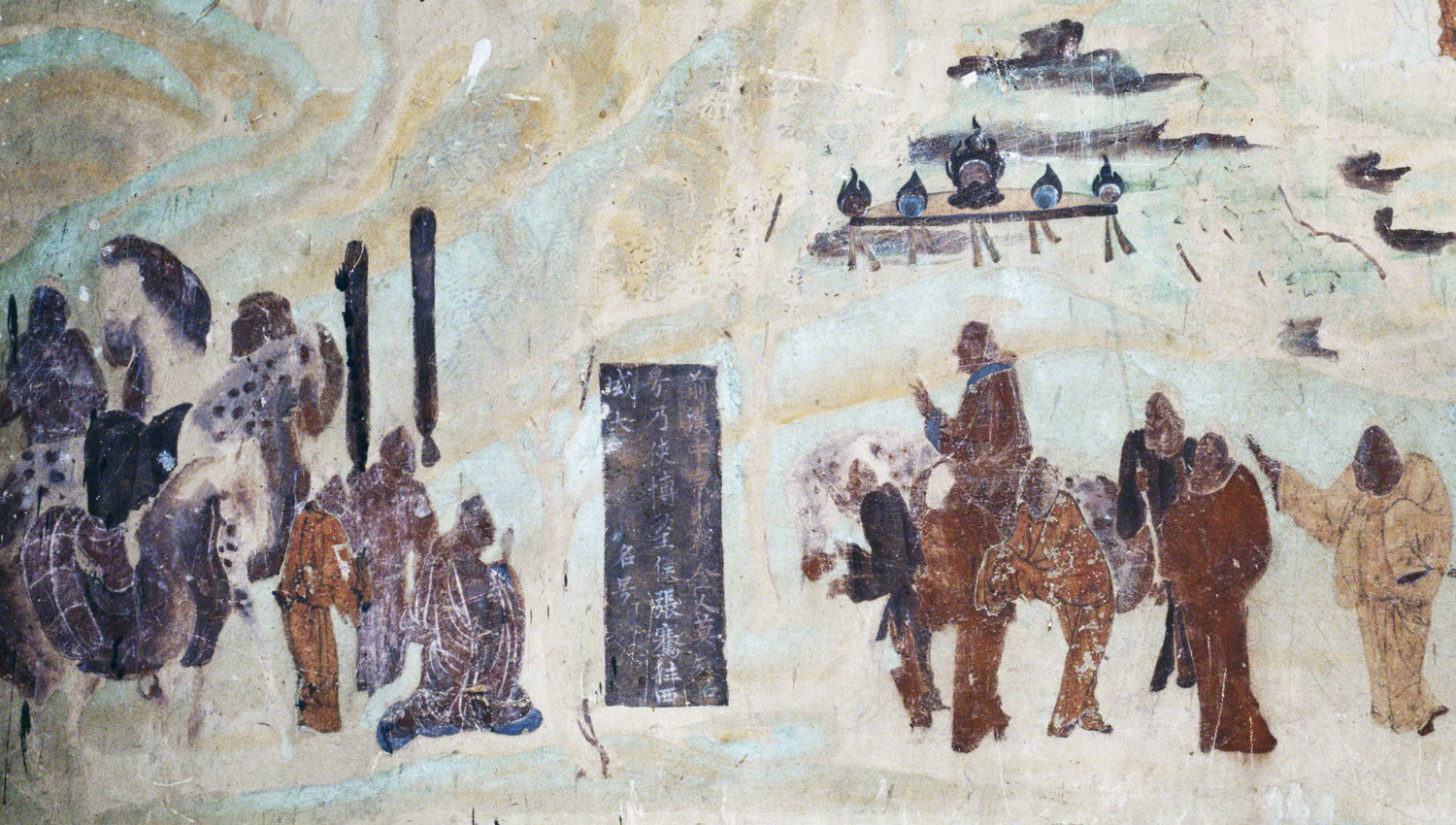
Detail of Emperor Wu on a horse sending off Zhang Qian who is kneeling, n wall fresco in Mogao Cave 323, seventh century, early Tang dynasty (image courtesy of the Dunhuang Academy)
Along with jataka tales, historical narrative paintings are likewise ubiquitous in the Mogao Caves. The paintings on the walls of Mogao Cave 323, dated to the vii th century during the Tang dynasty, detail stories of the origins of Buddhism in China, equally well equally early encounters with the religion in Mainland china. 1 narrative focuses on the Han dynasty Emperor Wu and the legend of two metal statues he worshiped that turned out to be early images of the Buddha.
Read essays most the Mogao Caves at Dunhuang
Mogao caves at Dunhuang: an overview
Read Now
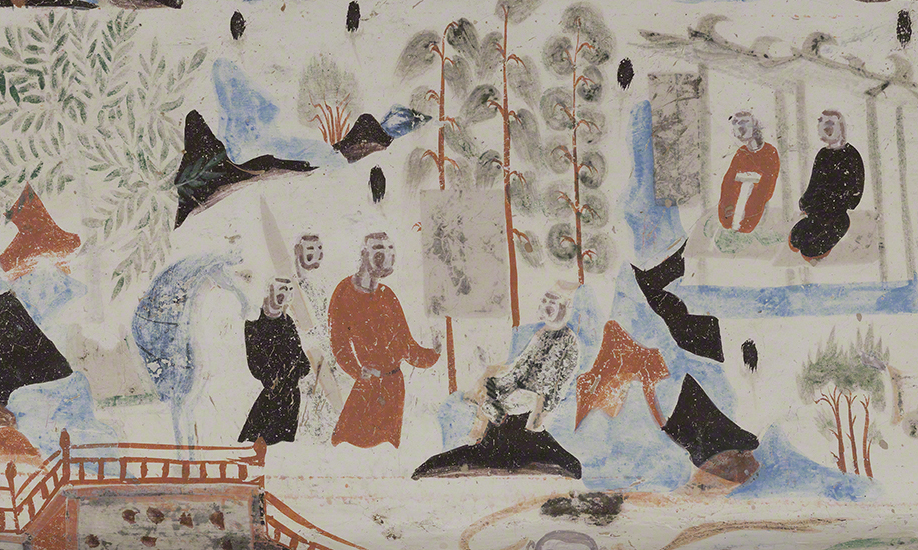
Cave 428: Jataka tales at Dunhuang
Read Now
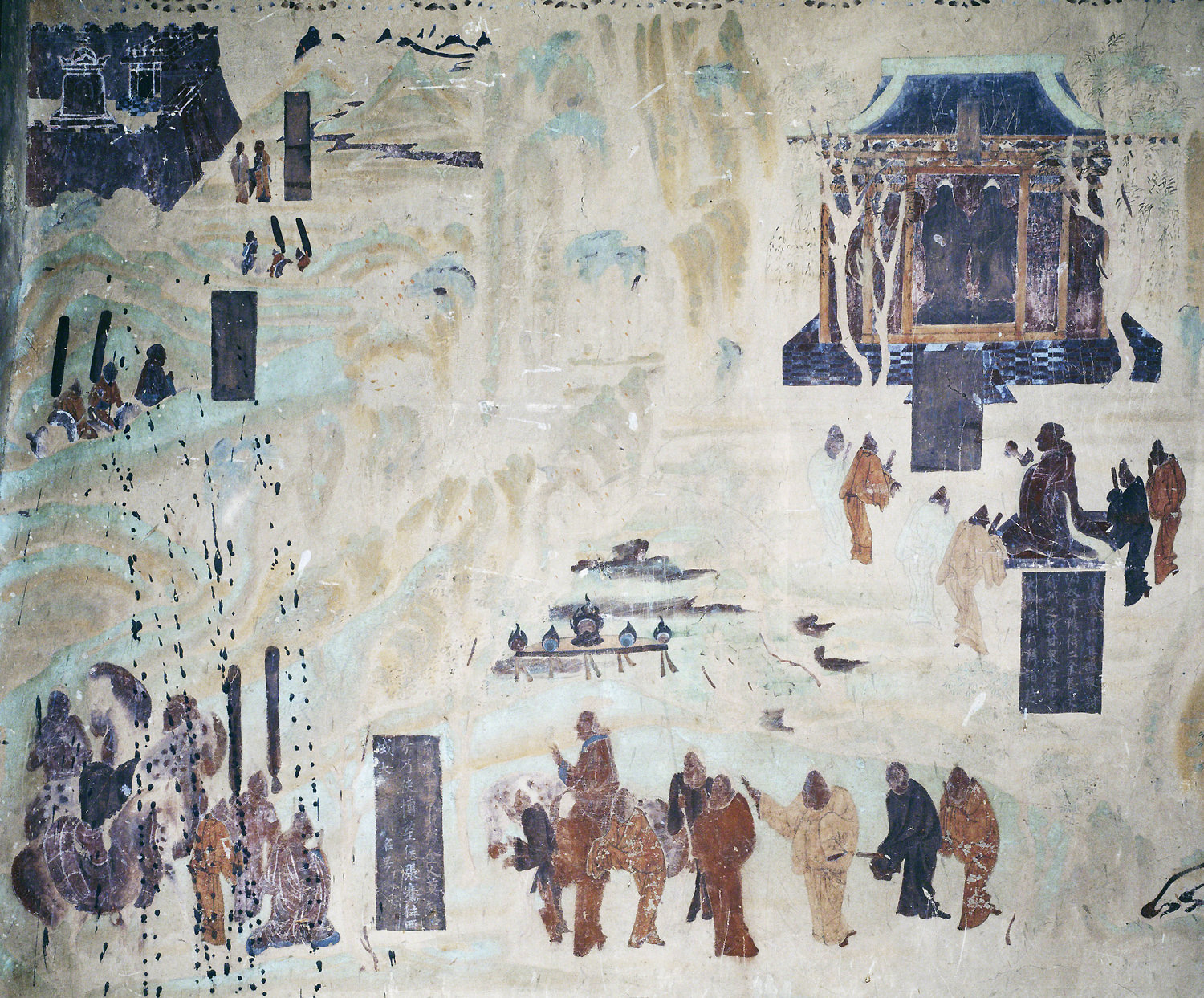
Cave 323: Early on encounters with Buddhism in China
Read Now
/three Completed
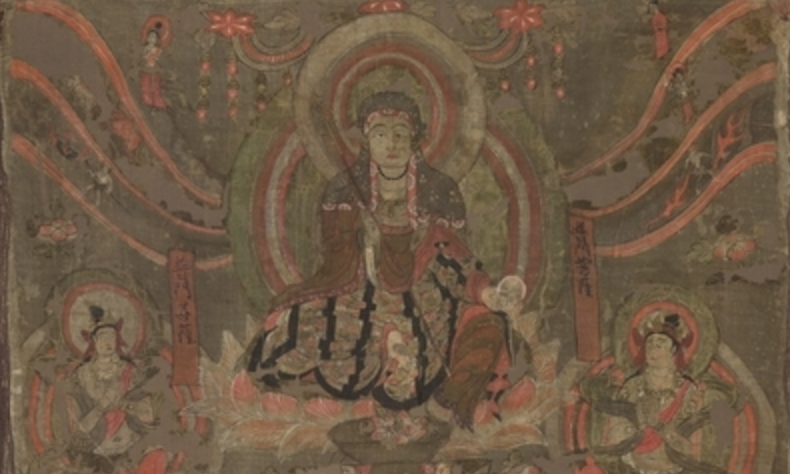
Cavern 17: The Library Cavern at Mogao
During the Ming dynasty (1368–1644), the Silk Roads were abased, and the Mogao Caves were all just forgotten. Withal, in 1900, a Chinese Daoist monk named Wang Yuanlu, self-appointed guardian of the caves, fabricated an astounding discovery: a hidden cavern filled, from floor to ceiling, with tens of thousands of aboriginal manuscripts, along with silk paintings and other historical artifacts which securely enrich our noesis of Buddhism and Buddhist cultures of the past.
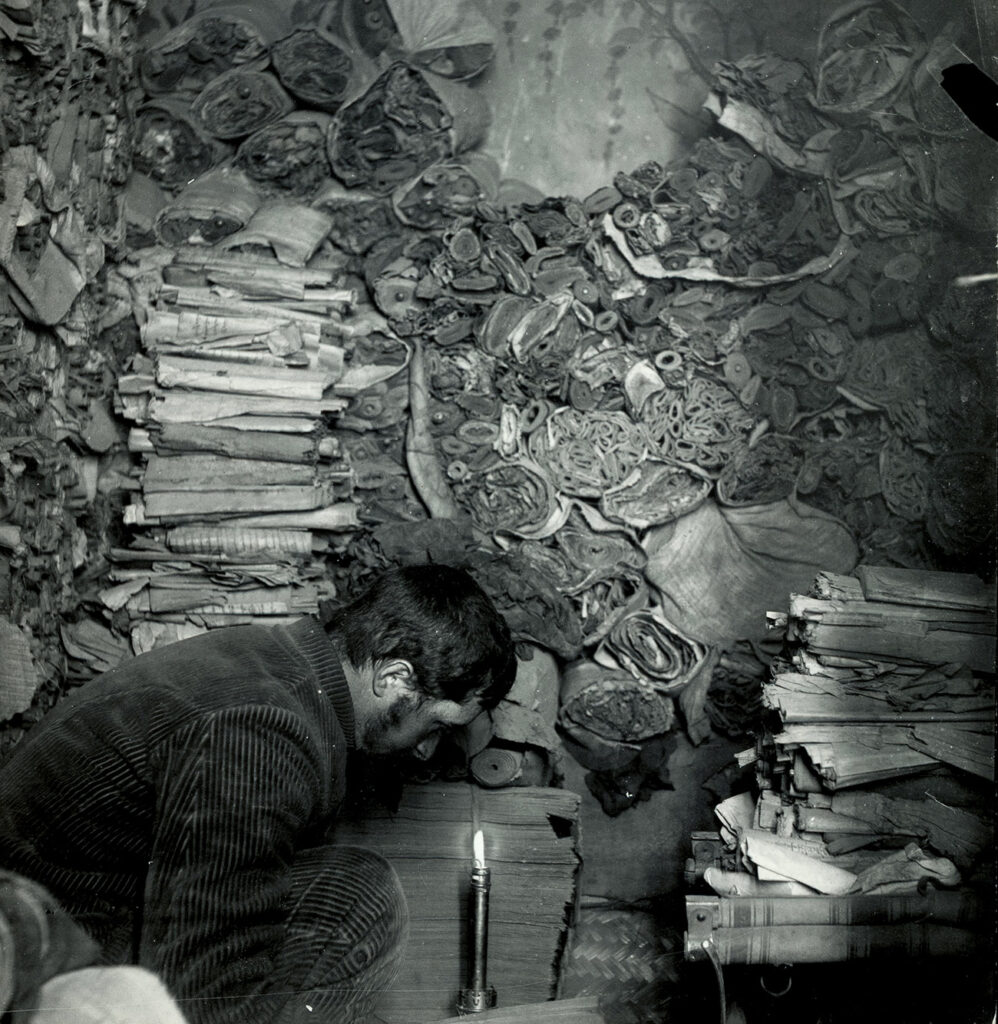
Mogao Caves 16–17 (Library Cavern), Dunhuang, Gansu Province, People's republic of china, 862 C.East.; sealed around g C.E. (photo courtesy of Dunhuang Academy)
Cave 17, called the "Library Cave," due to its abundant collection of manuscripts, was hidden within Cavern 16 and sealed in the 11 th century. Wang Yuanlu guarded the cave until the British archaeologist and explorer Marc Aurel Stein arrived and convinced him to sell a portion of the contents. Shortly after, Wang sold more manuscripts to the French Sinologist Paul Pelliot. Wang's sale of precious manuscripts and paintings from the cave is still highly controversial, but he did so to aid fund his dream of restoring the Mogao Caves. Today, for better or worse, the contents of the Library Cave are scattered across museum collections in Eurasia.

Remounted fragments (not in correct order) of the Dunhuang silk painting of auspicious images, seventh–8th centuries, Tang Dynasty, found in the "Library Cave" (Cave 17), Mogao grottoes, Dunhuang, Gansu province, People's republic of china (Stein no.: Ch.xxii.0023) (The British Museum)
The distribution of artifacts from the Library Cavern across museum collections makes the written report of these of import materials challenging. For example, fragments of one silk painting collected from Cave 17 by Marc Aurel Stein and dated to the Tang dynasty were eventually divided between ii split museum collections, the British Museum in London and the National Museum of Republic of india in New Delhi, complicating its reconstruction and interpretation.
Read two essays most Cave 17 at Mogao
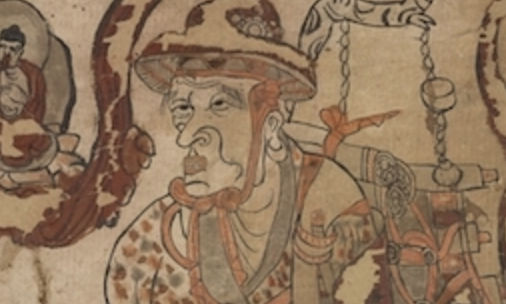
The paintings and manuscripts from cavern 17 at Mogao: an overview
Read Now

A silk painting from the Library Cave: Sacred Buddhist images from Dunhuang
Read At present
/2 Completed
Xiangtangshan Caves
The earliest caves at Xiangtangshan ("Mount of Echoing Halls") were carved during the Northern Qi dynasty (550–577) under the patronage of the royal family and officials. The caves, which number around thirty, are badly damaged due to centuries of human action (including looting), erosion, and natural disasters. However, like the materials from the Library Cave at Mogao, limestone sculptures and fragments of relief carvings from the Xiangtangshan caves are distributed in museum and private collections around the world.

Western Paradise of the Buddha Amitabha, Northern Qi dynasty, 550–577 C.E., limestone with traces of pigment, China, Hebei province, Fengfeng, southern Xiangtangshan, Cave 2, 159.3 loftier x 334.five cm (Freer Gallery of Fine art, Smithsonian Institution, Washington, DC: Purchase — Charles Lang Freer Endowment, F1921.two)
For example, a limestone relief in the National Museum of Asian Fine art in Washington, D.C., reveals the growth in popularity of Pure Country Buddhism during the 6 th century and is one of the earliest extant depictions of the Western Paradise, a heavenly palace setting practitioners believed they could be reborn into.
Read well-nigh a relief from a Xiangtangshan Cave

A relief of the Western Paradise of the Buddha Amitabha: An early depiction originally in a cave at Xiangtangshan.
Read Now
/1 Completed

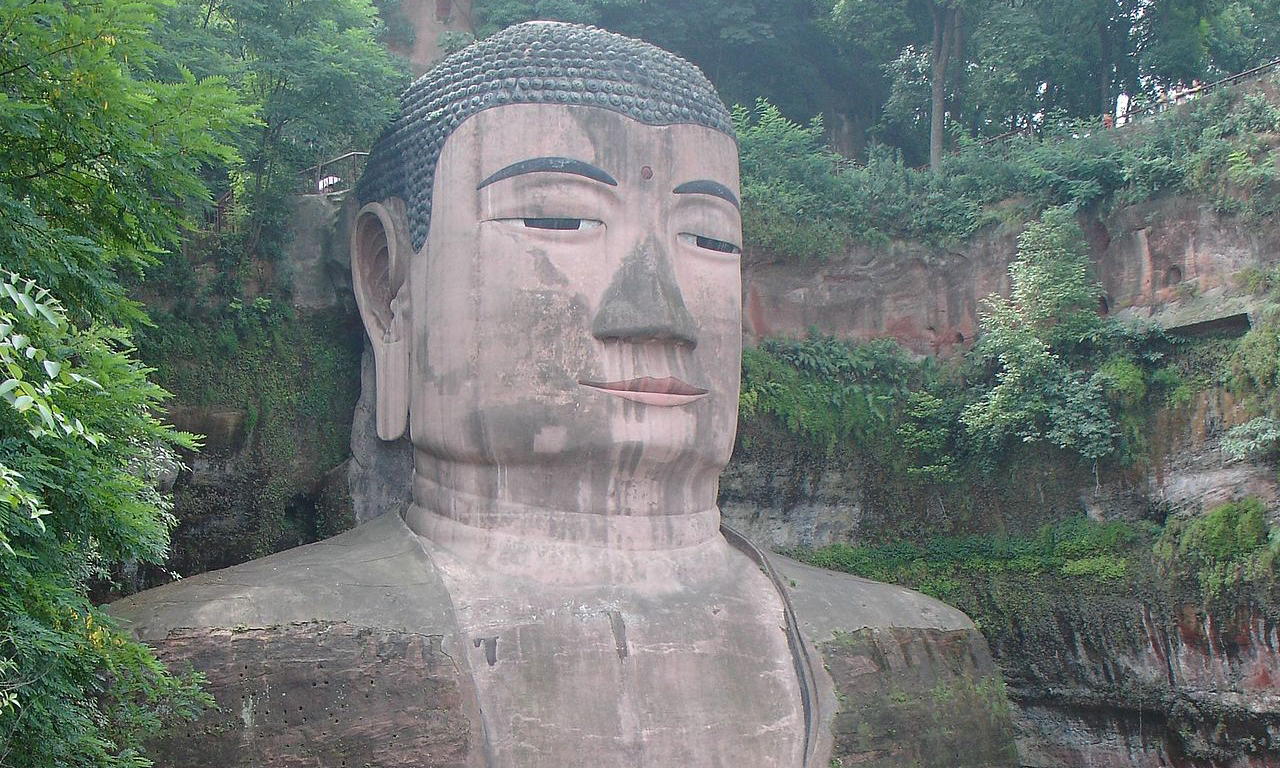
Behemothic Buddha, eighth century, Leshan, Communist china, 71 m high (photo: fannyss, CC0)
Leshan
Far away from Buddhist centers in the due north, the largest colossal paradigm of the Buddha in the earth was carved out of a hillside in the eight th century, not too far from Mahao cliff tomb in Sichuan province where ane of the earliest images of the Buddha was discovered (discussed to a higher place). Accounted the Giant Buddha of Leshan, the 71-meter-high seated Buddha looks out across the Min and Dadu Rivers towards Mount Emei. In dissimilarity to the colossal Buddhas represented in the caves at Yungang and Longmen, the Giant Buddha of Leshan was not synthetic to communicate the authority and legitimacy of a ruling family. Instead, the etching of the Buddha was sponsored past a Buddhist monk to oversee and protect ships passing by on the rivers below.
Watch a video about the Behemothic Buddha
Giant Buddha of Leshan: an introduction
Read Now
/1 Completed
Buddhism and the Afterlife
Subsequently his death, the Historical Buddha was cremated, and many practitioners of the faith chose to follow this practice. However, when Buddhism arrived in China there was already a centuries-long tradition of burial the expressionless in elaborate tombs with grave appurtenances to create a comfy and happy afterlife for the soul. Practitioners of the Buddhist religion in Mainland china who desired a traditional burial found ways to merge their faith in Buddhism with their views of the afterlife.
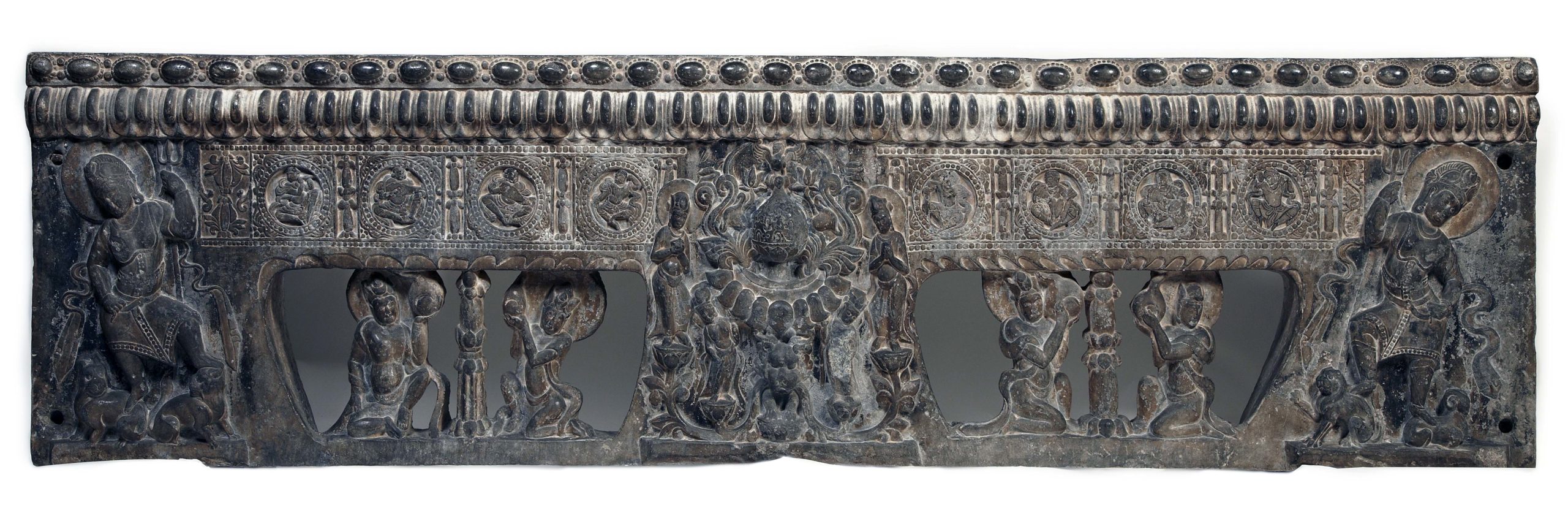
Frontal from the base of a funerary burrow with Sogdian musicians and dancers and Buddhist divinities, Northern Qi dynasty, Period of Partition, Northern Qi dynasty, 550–577 C.East., Grey marble with traces of pigment, Cathay, Henan province, probably Ce xian, lx.three high ten 234 ten 23.v cm (Freer Gallery of Art, Smithsonian Institution, Washington, DC: Gift of Charles Lang Freer, F1915.110)
For example, a stone slab from a funerary couch, which likely belonged to a noble living in northward Communist china during the Flow of Division, is adorned with images of Buddhist deities combined with secular imagery of Key Asian entertainers. The use of Central Asian motifs reflects the vibrant cultural exchange between Cathay and Cardinal Asia during this menstruum, while the combination of secular and religious imagery displays a convergence of cultural traditions and belief systems.
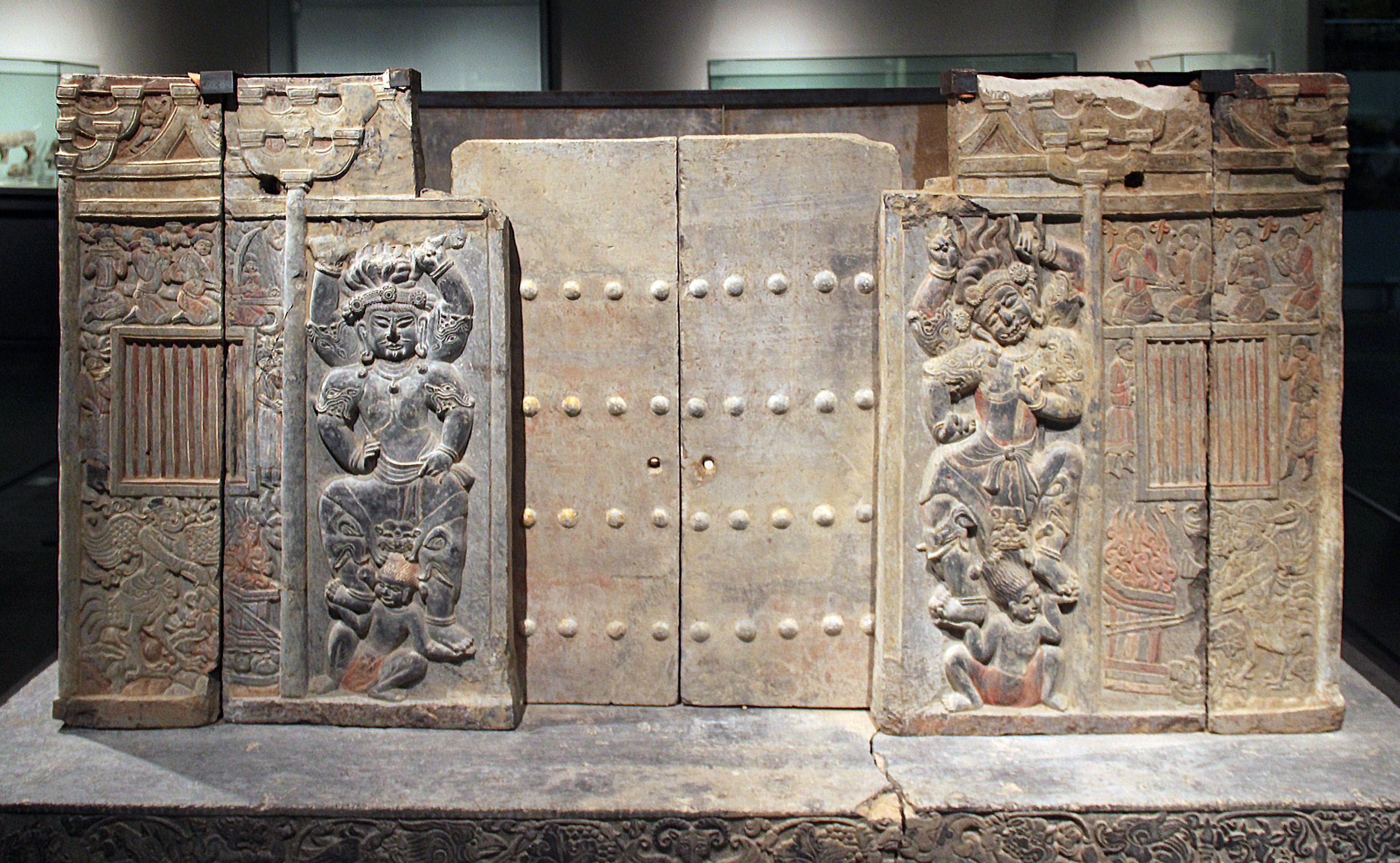
Wirkak or Shi Jun sarcophagus, 579–lxxx C.E., Northern Zhou dynasty, stone carvings with traces of pigment and gilding, China, Shaanxi Province (Eleven'an Museum, Shaanxi, China; photograph: Gary Todd)
Another funerary object that shows the confluence of cultures and faiths during the Menstruum of Division is a rock sarcophagus from the tomb of a Sogdian couple who traveled from Central Asia to Xi'an, Red china in the 6 th century. The sarcophagus is in the shape of a Chinese shrine and is covered with carved surface decoration. The surface ornamentation gives us a rare glimpse into the life of a foreign couple living in Cathay at the time. It details their lives from birth and union to expiry and the afterlife using narrative imagery. The sarcophagus besides highlights the impact of Buddhist art during this menstruation. Equally Jin Xu demonstrates in his essay on the Wirkak sarcophagus, the narrative illustrations of the Sogdian couple's life are modeled on carvings and paintings of the life of the Historical Buddha, such as those seen in the rock-cut cave monasteries discussed higher up.
Read essays about Buddhism and the afterlife
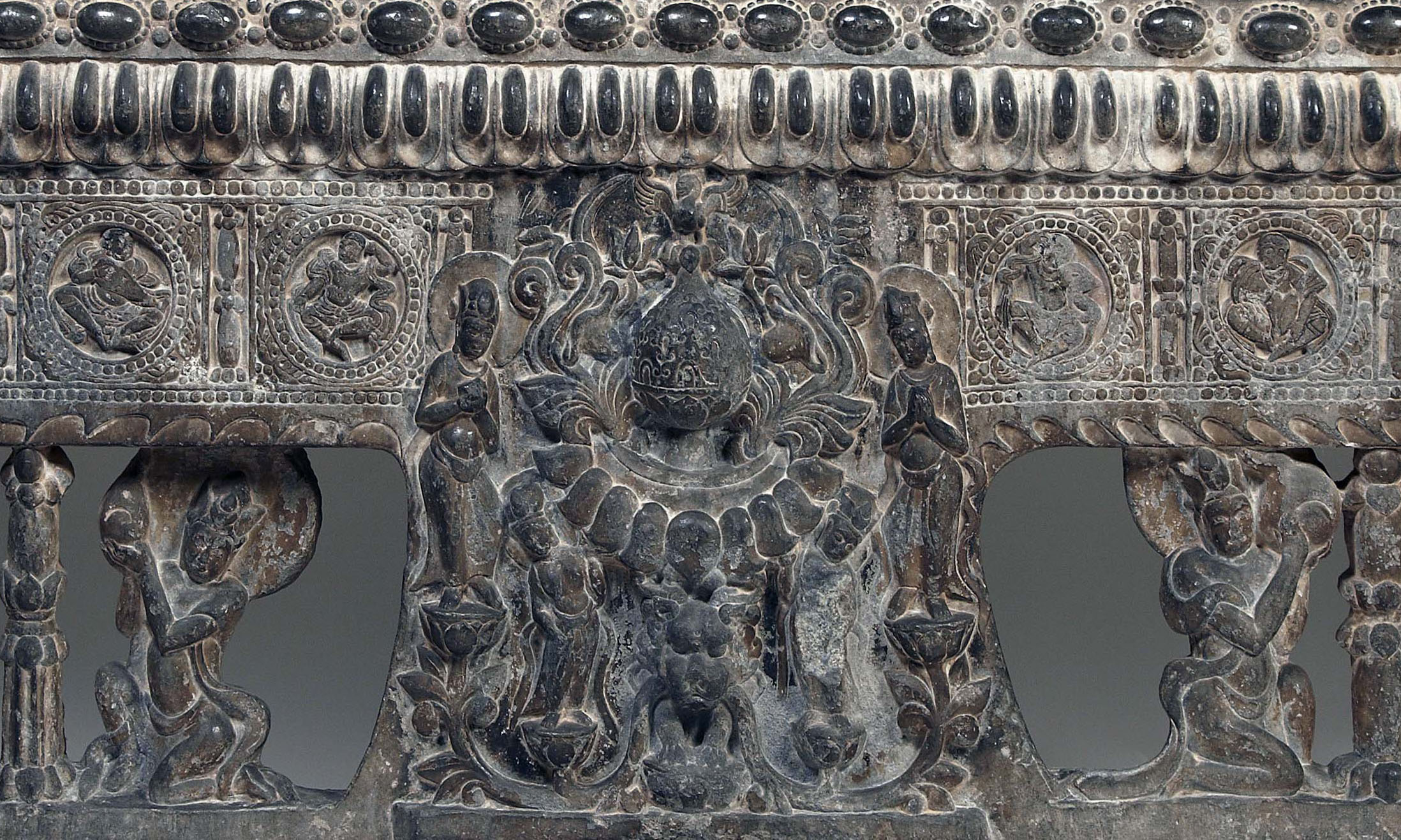
Base of a funerary couch: a combination of images of Buddhist deities combined with secular imagery of Cardinal Asian entertainers.
Read At present
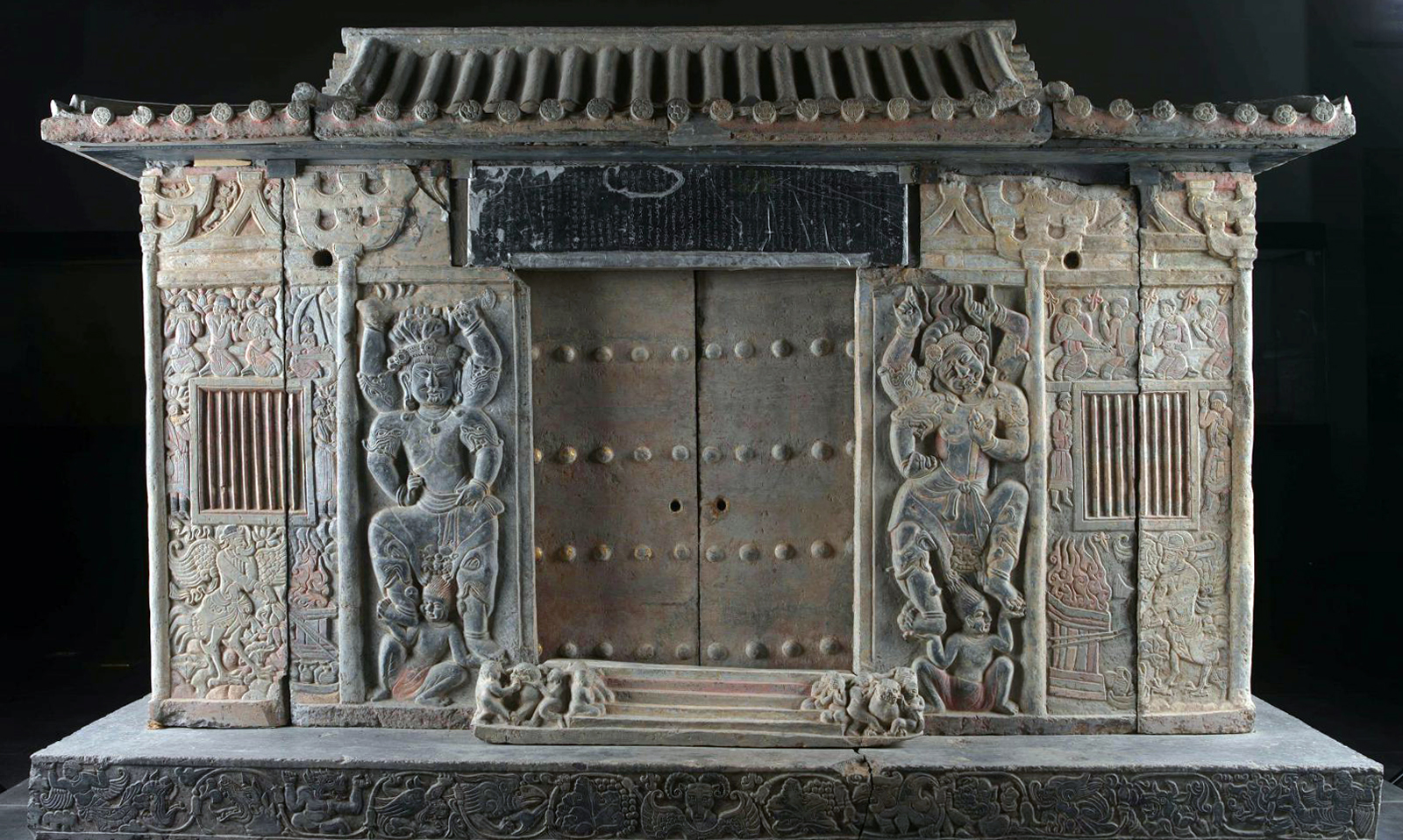
The Wirkak (Shi Jun) Sarcophagus: An object that shows the confluence of cultures and faiths during the Menstruum of Division.
Read At present
/ii Completed
As nosotros have seen in this affiliate, although at that place was a spark of Buddhist activity in China during the Han dynasty, the arrival of foreign nomadic groups in north China during the Menstruation of Division and their subsequent embrace of Buddhism had a profound and lasting impact on Chinese art. Subsequently reunification nether the Sui and the Tang dynasties, Han Chinese rulers connected to build upon the traditions established during the previous periods, embracing Buddhism and its multiculturalism.
Notes:
[i] The Kushans, who ruled over portions of nowadays-day Afghanistan, Pakistan, and northern India during the ane st through 3 rd centuries, were the first to depict the Buddha in human course.
[2] A pocket-size gold-plated bronze statue recently excavated from a tomb of a Chinese official dated to the belatedly 2 nd , early third century in Xianyang, Shaanxi province also follows a Gandharan prototype.The statue was excavated in 2021 from Tomb 3015 at Chengren, Xianyang, Shaanxi Province. The tomb contained ii statues considered to be amongst the earliest images of the Buddha discovered then far in China. An declaration of the discovery in English language can exist institute at: Alex Greenberger, "Earliest Gilt-Plated Statuary Buddha Statues Found in People's republic of china's Shaanxi Province," ARTnews.com, December 14, 2021.
[3] See Robert 50. Thorp and Richard Ellis Vinograd, Chinese Art & Culture (New York: Harry North. Abrams, Inc., 2001), pp. 201–203.
Key questions to guide your reading
How did Buddhist creative styles develop from the 2nd century through the early 10th century?
How did the construction of Buddhist monuments help legitimize the power and potency of rulers in Prc?
Leap down to Terms to Know
Source: https://smarthistory.org/reframing-art-history/buddhism-chinese-art/
0 Response to "Aranikos Artistic Legacy and Its Influence on the Buddhist Arts in China"
Enviar um comentário