Why Are Assumptions and Values Important to Know in Critical Reading?
Introduction
Learning Objectives
- define critical thinking
- identify the role that logic plays in critical thinking
- apply critical thinking skills to problem-solving scenarios
- apply disquisitional thinking skills to evaluation of information

Consider these thoughts about the disquisitional thinking process, and how it applies not just to our school lives but also our personal and professional lives.
"Thinking Critically and Creatively"
Critical thinking skills are perhaps the about fundamental skills involved in making judgments and solving problems. Yous use them every day, and you lot can continue improving them.
The power to think critically about a matter—to analyze a question, situation, or problem down to its virtually bones parts—is what helps us evaluate the accuracy and truthfulness of statements, claims, and information we read and hear. It is the abrupt knife that, when honed, separates fact from fiction, honesty from lies, and the accurate from the misleading. We all utilize this skill to one degree or some other almost every solar day. For case, we use critical thinking every twenty-four hours as nosotros consider the latest consumer products and why one particular production is the all-time amid its peers. Is it a quality production because a celebrity endorses it? Because a lot of other people may have used it? Because it is made by one visitor versus another? Or perhaps because it is made in 1 country or another? These are questions representative of critical thinking.
The academic setting demands more of us in terms of critical thinking than everyday life. It demands that we evaluate data and analyze myriad issues. It is the environment where our critical thinking skills can be the difference betwixt success and failure. In this environment we must consider data in an analytical, critical style. We must ask questions—What is the source of this information? Is this source an expert ane and what makes it so? Are there multiple perspectives to consider on an issue? Do multiple sources concord or disagree on an issue? Does quality inquiry substantiate information or opinion? Do I have any personal biases that may affect my consideration of this information?
Information technology is only through purposeful, frequent, intentional questioning such every bit this that nosotros can acuminate our critical thinking skills and improve every bit students, learners and researchers.
—Dr. Andrew Robert Bakery, Foundations of Bookish Success: Words of Wisdom
Defining Critical Thinking
Thinking comes naturally. You don't accept to go far happen—it just does. But you can make it happen in different ways. For instance, you can think positively or negatively. You tin think with "heart" and you tin can think with rational judgment. Yous can also think strategically and analytically, and mathematically and scientifically. These are a few of multiple ways in which the mind can process thought.
What are some forms of thinking you employ? When do you use them, and why?
As a college student, you are tasked with engaging and expanding your thinking skills. One of the most important of these skills is disquisitional thinking. Critical thinking is important because information technology relates to nearly all tasks, situations, topics, careers, environments, challenges, and opportunities. It'south not restricted to a item subject field area.

Critical thinking is articulate, reasonable, reflective thinking focused on deciding what to believe or do. It ways asking probing questions similar, "How do we know?" or "Is this true in every case or just in this instance?" It involves being skeptical and challenging assumptions, rather than but memorizing facts or blindly accepting what you hear or read.
Imagine, for example, that y'all're reading a history textbook. You lot wonder who wrote it and why, because yous detect certain assumptions in the writing. You find that the author has a limited telescopic of research focused merely on a particular group within a population. In this case, your critical thinking reveals that at that place are "other sides to the story."
Who are critical thinkers, and what characteristics practise they have in common? Disquisitional thinkers are usually curious and reflective people. They like to explore and probe new areas and seek knowledge, clarification, and new solutions. They ask pertinent questions, evaluate statements and arguments, and they distinguish between facts and opinion. They are as well willing to examine their ain beliefs, possessing a fashion of humility that allows them to admit lack of knowledge or understanding when needed. They are open to changing their heed. Perhaps almost of all, they actively savour learning, and seeking new knowledge is a lifelong pursuit.
This may well exist you!
No matter where you are on the road to being a critical thinker, you tin ever more fully develop your skills. Doing so will help you develop more balanced arguments, express yourself clearly, read critically, and absorb important information efficiently. Disquisitional thinking skills will help you in any profession or whatsoever circumstance of life, from science to art to business to educational activity.
| Disquisitional Thinking IS | Critical Thinking is Non |
|---|---|
| Skepticism | Memorizing |
| Examining assumptions | Grouping thinking |
| Challenging reasoning | Blind acceptance of authority |
| Uncovering biases |
Disquisitional Thinking in Action
The following video, from Lawrence Banal, presents the major concepts and benefits of critical thinking.
Critical Thinking and Logic
Critical thinking is fundamentally a process of questioning information and data. You may question the data you read in a textbook, or you may question what a pol or a professor or a classmate says. You can also question a commonly-held conventionalities or a new thought. With critical thinking, annihilation and everything is subject to question and examination.
Logic's Human relationship to Critical Thinking
The word logic comes from the Ancient Greek logike, referring to the science or art of reasoning. Using logic, a person evaluates arguments and strives to distinguish betwixt good and bad reasoning, or between truth and falsehood. Using logic, you lot can evaluate ideas or claims people make, make expert decisions, and class sound beliefs near the world.[one]
Questions of Logic in Critical Thinking
Let'southward use a simple instance of applying logic to a disquisitional-thinking situation. In this hypothetical scenario, a man has a PhD in political scientific discipline, and he works as a professor at a local higher. His wife works at the college, too. They have iii young children in the local schoolhouse organisation, and their family is well known in the customs.
The human being is now running for political function. Are his credentials and experience sufficient for entering public office? Will he be constructive in the political office? Some voters might believe that his personal life and electric current job, on the surface, propose he volition practice well in the position, and they will vote for him.
In truth, the characteristics described don't guarantee that the human being will do a good job. The information is somewhat irrelevant. What else might yous want to know? How about whether the man had already held a political office and done a good job? In this case, we want to ask, How much data is acceptable in order to make a decision based on logic instead of assumptions?
The following questions, presented in Figure i, below, are ones you may apply to formulating a logical, reasoned perspective in the above scenario or any other situation:
- What's happening? Get together the basic data and begin to think of questions.
- Why is it of import? Ask yourself why it's significant and whether or not you agree.
- What don't I see? Is at that place annihilation important missing?
- How practice I know? Inquire yourself where the information came from and how information technology was constructed.
- Who is saying it? What's the position of the speaker and what is influencing them?
- What else? What if? What other ideas exist and are there other possibilities?
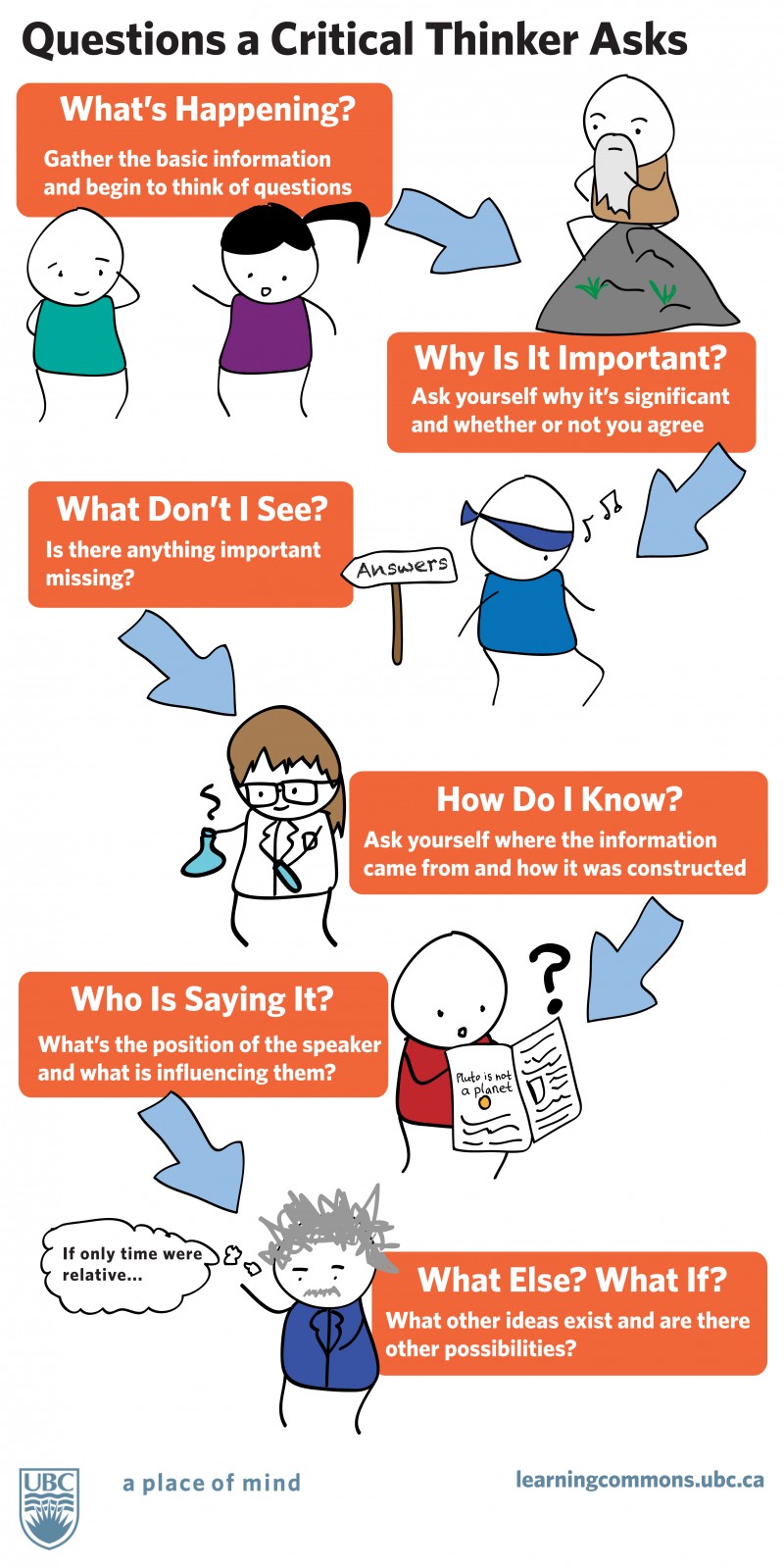
Figure 1
Trouble-Solving With Disquisitional Thinking
For nigh people, a typical mean solar day is filled with disquisitional thinking and trouble-solving challenges. In fact, critical thinking and trouble-solving become manus-in-hand. They both refer to using knowledge, facts, and information to solve problems effectively. But with problem-solving, you are specifically identifying, selecting, and defending your solution. Beneath are some examples of using critical thinking to problem-solve:
- Your roommate was upset and said some unkind words to you, which put a crimp in your relationship. You try to encounter through the angry behaviors to decide how you might best back up your roommate and help bring your relationship back to a comfy spot.
-
 Your campus club has been languishing on account of lack of participation and funds. The new club president, though, is a marketing major and has identified some strategies to interest students in joining and supporting the social club. Implementation is forthcoming.
- Your final art class project challenges you lot to conceptualize form in new ways. On the terminal twenty-four hours of class when students nowadays their projects, you lot depict the techniques y'all used to fulfill the assignment. You explicate why and how yous selected that approach.
- Your math teacher sees that the class is not quite grasping a concept. She uses clever questioning to dispel anxiety and guide y'all to new understanding of the concept.
- You have a job interview for a position that you experience you are only partially qualified for, although you really want the job and y'all are excited virtually the prospects. You analyze how you volition explain your skills and experiences in a way to show that yous are a adept match for the prospective employer.
- Yous are doing well in college, and nigh of your college and living expenses are covered. But in that location are some gaps between what you want and what you experience you tin can afford. You lot analyze your income, savings, and budget to better calculate what you will need to stay in college and maintain your desired level of spending.
Problem-Solving Action Checklist
Problem-solving can exist an efficient and rewarding process, particularly if yous are organized and mindful of critical steps and strategies. Retrieve, too, to assume the attributes of a good critical thinker. If you are curious, cogitating, knowledge-seeking, open to change, probing, organized, and ethical, your challenge or problem volition be less of a hurdle, and you'll exist in a skilful position to find intelligent solutions.
| STRATEGIES | Activity CHECKLIST[2] | |
|---|---|---|
| 1 | Define the problem |
|
| 2 | Identify available solutions |
|
| 3 | Select your solution |
|
Evaluating Information With Critical Thinking
Evaluating information can be one of the most complex tasks you will be faced with in college. Only if you utilize the post-obit iv strategies, you lot will exist well on your way to success:
- Read for understanding by using text coding
- Examine arguments
- Analyze thinking
- Cultivate "habits of mind"

i. Read for Agreement Using Text Coding
When y'all read and take notes, use the text coding strategy. Text coding is a way of tracking your thinking while reading. Information technology entails marking the text and recording what you are thinking either in the margins or perhaps on Post-it notes. As you brand connections and inquire questions in response to what you read, you monitor your comprehension and heighten your long-term agreement of the cloth.
With text coding, mark important arguments and key facts. Indicate where you hold and disagree or have further questions. You don't necessarily need to read every word, but make sure you lot understand the concepts or the intentions behind what is written. Feel free to develop your own shorthand manner when reading or taking notes. The post-obit are a few options to consider using while coding text.
| Shorthand | Meaning |
|---|---|
| ! | Of import |
| L | Learned something new |
| ! | Big idea surfaced |
| * | Interesting or important fact |
| ? | Dig deeper |
| ✓ | Agree |
| ≠ | Disagree |
Run across more text coding from PBWorks and Collaborative for Instruction and Learning.
2. Examine Arguments
When yous examine arguments or claims that an author, speaker, or other source is making, your goal is to place and examine the hard facts. You tin can employ the spectrum of authorisation strategy for this purpose. The spectrum of authority strategy assists you in identifying the "hot" end of an argument—feelings, beliefs, cultural influences, and societal influences—and the "cold" terminate of an statement—scientific influences. The following video explains this strategy.
iii. Clarify Thinking
When yous utilize critical thinking to evaluate information, yous demand to analyze your thinking to yourself and likely to others. Doing this well is mainly a process of request and answering probing questions, such as the logic questions discussed earlier. Design your questions to fit your needs, but exist sure to embrace acceptable ground. What is the purpose? What question are we trying to answer? What bespeak of view is existence expressed? What assumptions are we or others making? What are the facts and data we know, and how do we know them? What are the concepts we're working with? What are the conclusions, and do they make sense? What are the implications?
4. Cultivate "Habits of Mind"
"Habits of mind" are the personal commitments, values, and standards you have well-nigh the principle of good thinking. Consider your intellectual commitments, values, and standards. Do you approach problems with an open up mind, a respect for truth, and an inquiring mental attitude? Some good habits to have when thinking critically are existence receptive to having your opinions changed, having respect for others, being independent and non accepting something is truthful until yous've had the time to examine the available bear witness, being fair-minded, having respect for a reason, having an inquiring mind, not making assumptions, and always, particularly, questioning your own conclusions—in other words, developing an intellectual work ethic. Endeavour to work these qualities into your daily life.
Self-Check
Source: https://courses.lumenlearning.com/basicreadingandwriting/chapter/outcome-critical-thinking/
0 Response to "Why Are Assumptions and Values Important to Know in Critical Reading?"
Enviar um comentário